Sunday, March 9, 2014

GIVEAWAY: Listen, It's [Dot] Complicated


"A successful woman is one who can build a firm
foundation with the bricks others have thrown at her."
[modified from an original quote by David Brinkley]

Several months ago the amazing folks at Zuckerberg Media contacted me about reading, reviewing, and offering up a giveaway of Randi Zuckerberg's Dot Complicated: Untangling Our Wired Lives. If you're not sure who Randi is, but you recognize that obviously recognizable last name, yes, she's related to the illustrious Mark of Facebook fame. What you might not know is that Randi was the mastermind behind some of Facebook's most amazing and groundbreaking live streaming initiatives and relationships with big dogs like CNN and ABC.

As the master of her own company and life now, having written this stellar read about her experiences at Facebook and how she got out and launched herself, she's also a published children's book author. Her first masterpiece? Dot., a book for children about putting down the tech and enjoying life. In this children's book, the flutters and noises of technology are found outside, too, whether it's surfing down a hill or listening to the twitter of the birds. It's a beautiful pairing with her Dot Complicated book for adults. I envision myself sitting down to reread Randi's book someday with Ash sitting next to me with Dot. Sort of a his and her's experience, except in this case, it'll be a tech savvy mommy's and a tech savvy baby's experience.

In Dot Complicated, Randi is casual and paints one of the most vivid pictures of a life experience I've read in recent years. As a work of nonfiction, her honesty and candid reflections about being "Mark Zuckerberg's sister" and her breaking point when she realized that she had to get out and do her own thing in a big way. Her narrative is inspiring and I have no doubt in my mind that she's paving the way for future generations of women -- both through her children's book and her book for more adult-like individuals.

I also have to applaud her realistic approach to technology and how it is shaping our lives in positive and negative ways. Early on in the book she says the following:
The famous science-fiction writer Arthur C. Clarke once said, "Any sufficiently advanced technology is indistinguishable from magic." He was right. New technology is a kind of magic and today we can do things with ease that were impossible just a few years ago. Like magic, each new innovation has advanced our society and our potential. Of course, the seductive glow of these magical devices can also blind us to some of their downsides and effects." (57)
Her jaunts into her journey took me back to the days of AIM and the melancholy of being a teenager and college study.
Remember the effort you'd make to choose the perfect IM profile picture, or the time you invested in crafting the perfect "away" message? I admit that I spent way too much time selecting vague but meaningful lyrics from the latest song I was obsessed with. Plenty of times I would announce my presence online with "I believe I can fly," "I saw the sign," or "I get knocked down." (71)
Yes, I used to have "Sleep, those little slices of death" (a la Edgar Allen Poe) as one of my away messages. I was the original when it came to super vague and sometimes frightening posts in the "social" sphere.

Randi's take on the merging of the public and private spheres also had me rolling my fist in the air Arsenio Hall style.
"It can't be that we're going to have to adjust to a world where we cannot share anything but our utmost public and sterile information. Sharing the personal stuff with others is an essential aspect of what it means to be human. If our online lives are to be as fulfilling as our offline ones, and if those two lives are to be fully integrated, then as we go forward we need to find a way to bring back personal information online. We must be able to post some pool pics without the whole world finding out, even if one of our friends is feeling a little overenthusiastic with the share button that day. (80)
Preach! Now that's a manifesto. As someone whose life is very public by my own choice, I can't say enough about the truth in Randi's sentiments. I don't believe in separating the two, and neither does Randi. Huzzah!

I will say that one thing that slightly bummed me out, although not in a big way, was her reflections on being a Jewish woman and mother. A quick reference to Chinese food on Christmas a Jewish woman entrepreneur does not make.

That aside, probably the most valuable piece of actionable advice Randi dishes out is that everyday, you have to pick three from the following and that's it. You can't do it all, so pick three and make them work. And don't feel guilty about it either.

  • Work
  • Sleep
  • Family
  • Friends
  • Fitness
I remember reading this before Ash was born and thinking "YES! What a great approach to life." Have I enacted the "pick three" philosophy? No. But guess what? Starting tomorrow, I'm going to because, let's be honest, I've been trying to pack four of those into every day (sorry, fitness). And maybe, maybe someday we'll all work for a company like FullContact in Denver, Colorado, which pays their employees $7,500 bonus if they don't take their phones with them on vacation. A girl can dream, right? (168)

Oh, and I don't forget: 
"The more successful you are and the more you have to say, the more people will be mean to you on the Internet. The only way forward is to embrace your haters. Don't be afraid of the keyboard cowards. Engage them." (237)
Have I sold you yet on Dot Complicated? If you haven't read the book already and are seriously jonesing for some mind-blowingly awesome writing, storytelling, and inspiration, hold tight! It's time for a giveaway. 

To be entered to win:
  • Comment on this post and you'll be entered to win a copy of Dot Complicated!
  • Share this blog post to Twitter and/or Facebook for an extra chance to win. You must include in your comment that you've posted on these social sites for the extra chances (i.e., "I'm commenting on your blog post to win this awesome book, and I also shared on Twitter and Facebook.")
  • Contest is open to U.S. residents only.
I'll draw a winner at random on Wednesday, March 19 at midnight (EST). 


Tuesday, February 25, 2014

Back from the U.S. and ...

Photo taken by my mom, Debbie, at the Omaha airport before
we hopped on the first of three legs of air travel back to Israel. 

Oh hello there blog. What? I've been neglecting you? Yes, yes I have. With traveling back and forth to the U.S., work, and raising the fastest growing bundle of cute ever, I haven't been as active here on the blog as I want to be. I've got a bucketload of book reviews (including a few cookbooks of mention), a book giveaway, and tons of pictures and insights about being back in the U.S. to share. It'll take some time, but I'll get it all up. I promise.

The first and quickest thing I have to say?

Flying back into Israel, I always felt a rush of "I'm home!" in the past. Every trip I got the same sensation. This was the first time since 2009 that I saw the coastline and my thoughts turned to, "Is this really home? Is this really where I'm happiest?" I then reminded myself that home is where the heart is, and for me, home is where Ash and Mr. T are. They're here, I'm here, and thus, that's where my happiness can be found (for now anyway).

The U.S. was a time of comfort, a time where I could go to any grocery store and easily find vegetarian, vegan, and gluten-free products worth eating. Where convenience foods were just that, and I didn't have to think about cooking something from absolute scratch in order to be able to eat. It seems like a shallow, superficial thing to care about, but with the diet I'm sporting these days (gluten free as always, but now without many eggs, and without any dairy) it's hard to live in Israel.

But more on that later.

Also? Adventures in breast feeding were fun. That's going to be a post, without a doubt.

Time to go snuggle with the hubsters and little one. We're all sick, so we make for good company. Happy company, that is.

Friday, February 7, 2014

That Woman: We're Heading Stateside


We're seven weeks in to life with Ash, and it's magical.

Magical.

The first few weeks are hard and exciting, then things get rough if and when baby gets colicky, so you try a few things, figure out a plan, and attack. Then baby gets better, happier, and then the cooing and moments-that-sound-like-giggles-but-aren't-exactly start and it's falling in love like the first moment all over again.

I've learned to truly appreciate the Asher Yatzar blessing that Jews recite after going to the bathroom thanking HaShem for the proper functioning of the body. With a colicky baby whose gas and reflux make him a mini Godzilla, you realize the blessing of communication and proper body function. Can you imagine not having the ability to say "it hurts here, please help me" ...? That's a baby's life.

And now, with baby having calmed down a bit, we're off to the United States so he can meet his Grandma Deb and Grandpa Bob, his Uncles John and Joe, his cousins Owynn and Oliver, and his Aunt Jess. And ... maybe, just maybe ... he'll meet another new cousin if she shows up on time.

I'm scared to death of becoming "that woman" on the plane. You know, the one with the screaming child that won't calm down. I don't sleep on planes in any circumstances anyhow, so I don't mind being up and about with Ash while Mr. T catches some Zzzzs, but being "that woman" has always been my greatest fear when it comes to parenthood.

Assuming all goes well and the three legs of the flight go according to plan, we'll be stateside on Tuesday for a few weeks in Nebraska and Colorado. I'm hoping for snow, lots of cold weather, and all of the comforts of being back in familiar surroundings (Target, gluten-free and vegan food out my ears, and the ease and quiet of a life I know well).

I'll admit I'm anxious about going home. The fact that I call it home is enough to get me lashed here in Israel, too.

When you make aliyah to Israel, you are home. Right? But I still refer to Nebraska as home. If home is where the heart is, does it mean my heart is in the U.S.? Does it mean I'm not really committed to life in Israel?

It's stupid that I'm eager to shop at Trader Joe's and pick up the gluten-free food that made life easy and liveable back in the U.S. I'm excited to go to Target where the clothes are inexpensive and fit me. I'm elated to see coworkers I haven't met yet and to spend even half a day working with them in a "normal" work environment for the first time in a year and a half. But at the same time, it isn't stupid. It's just the life I know. The life I've been comfortable with. It's the life I know how to live. Emotionally and financially.

Since Ash was born, I've been scared to death of postpartum depression because of what I've been through in the past. I've been keeping the most obsessive and close tabs on it. Luckily, I haven't been experiencing depression.

But am I happy?

There's something a little askew right now, and I'm worried that going home is going to show me that little bit that I'm missing. That nudge of what I need to feel stable. And then what?

I suppose we'll see what two weeks in the U.S. does for me. Maybe I'll have the reaction of some friends that people in the U.S. are commercially obsessed and life there is miserable. I have an inkling that it will be quite the opposite of reactions.

Either way, I hope Ash doesn't make me "that woman" on the plane. Let's start there.  

Tuesday, January 28, 2014

Sitting in the Catbird Seat


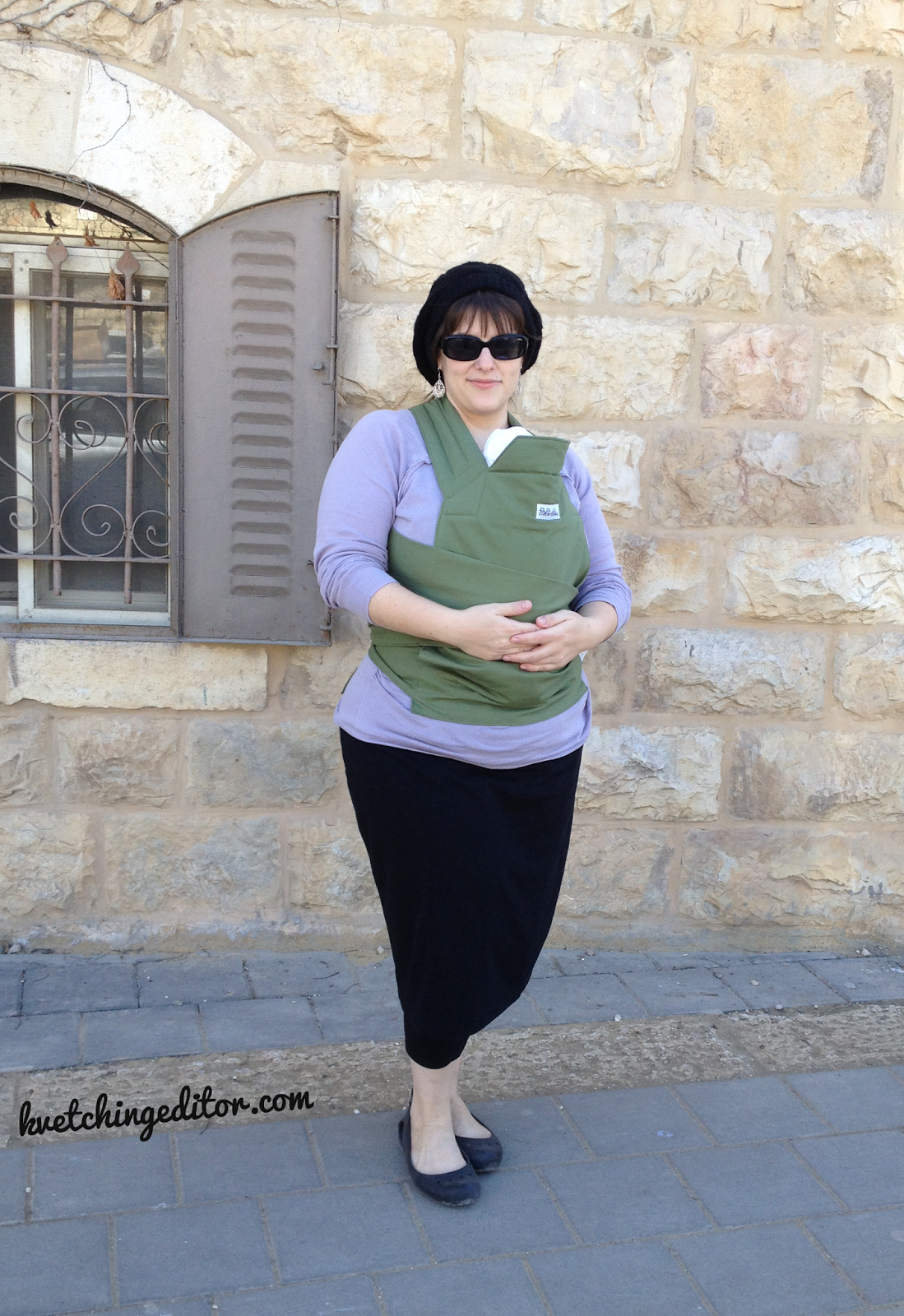
Note: I'm actually not wearing the carrier right here. The 
front strap around my abdomen is meant to be folded up 
and under, creating a sort of pocket for baby. D'oh! 


I'm not sure if it's a good or bad thing, but this blog is quickly becoming a family-oriented mommy blog with a Jewish twist. Who would have thought when I started “Just Call Me Chaviva” nearly eight years ago that such an evolution would occur, right?

So keeping with the theme of all things baby and family, I've partnered with Chicago-based Catbird Baby to delve into the fun and versatile world of babywearing.

Catbird Baby carriers
For those not in the know, never fear, I haven't turned Ash into a clever fascinator or stylish handbag. Babywearing is the art of schlepping your little one to and fro in one of dozens and dozens of different types of carriers. An evolution all its own, babywearing used to be the only way to tote your kid because it was allowed for work + caring for baby. Strollers (or buggies if you prefer) took over for a long time, but at some point babywearing was rekindled as all the rage, and in Israel babywearing is an art form all its own.

Mr. T and I were down with babywearing from the beginning, which for us has been convenient because the stroller we purchased is waiting for us in Nebraska, where we're heading next month to visit family and pick it up (it was 1/4 the price in the U.S. as here). Short of carrying Ash everywhere in the carseat, babywearing has been a necessity.

When wearing Ash, our hope and goal is that he'll happily feel like he's in the "catbird seat." I'll be honest: I was unfamiliar with the term before hearing about Catbird Baby, but now it makes sense when it comes to babywearing.
According to the Oxford English Dictionary, the first recorded usage occurred in a 1942 humorous short story by James Thurber titled "The Catbird Seat," which features a character, Mrs. Barrows, who likes to use the phrase. Another character, Joey Hart, explains that Mrs. Barrows must have picked up the expression from Red Barber, a baseball broadcaster, and that to Barber "sitting in the catbird seat" meant "'sitting pretty,' like a batter with three balls and no strikes on him."
With Ash, especially because he's still so young, being bundled all close and cozy to mom or tatty is hugely important because it provides him a sense of safety and security (not to mention he falls asleep a lot quicker when he's cuddled super close). With babywearing, he's in his own catbird seat because he's reaping the benefits of that close, secure positioning that carriers like the pikkolo and mei tei provide, and that a stroller simply doesn't. I can't wait until he's a little bit older and his neck support is awesome enough that we can wear him facing forward so he really will be sitting pretty, seeing everything the world has to offer.

Stay tuned for more detailed reviews of Catbird Baby's carriers, including some thoughts from the peanut gallery Mr. T (who, by the way, doesn't like the Ergo and preferred the Moby until we got these carriers). Also: Be sure to let me know if you've got a favorite carrier!

Note: Catbird Baby has provided me with pikkolo and mei tei carriers at no charge for our blogging partnership. That being said, I did have to pay duty and VAT on the carriers once they arrived in Israel, which was a huge bummer and quite expensive. All product reviews on this blog reflect my own honest opinion, however pleasant or harsh they may be.

Tuesday, January 14, 2014

Cloth Diapering: It Begins!

When Mr. T and I found out we were preggo, we began having conversations sporadically about things like co-sleeping, pacifiers, and cloth diapering. Oddly enough, because I'd never fully committed to having kids, I'd never really considered all of the options out there for how and when and where and why to raise a child.

Mr. T was very anti-pacifier (pro thumb), in favor of co-sleeping, and most definitely down with cloth diapering. I'm a big believer that you can get rid of a pacifier, but a thumb is forever, and in Israel there are a lot of kids pushing 10 years old that are still sucking their thumbs, so I made my opinions on this clear from the start. Co-sleeping scared the daylights out of me because I'm a pretty messy and aggressive sleeper because I simply don't sleep well. Covers on, covers off, covers on the floor, pillows here, there, and everywhere ... the thought of having a baby in bed with me just horrified me. But cloth diapers, that was something we could agree on.

(Note: Since the baby was born, of course, everything has gone out the window. Ash is trying to suck his thumb and we're waiting with breath bated for him to figure it out, because he won't take a pacifier. I've been co-sleeping since our first night in the baby hotel because he won't sleep alone, and so far he's still alive and well.)

Having lived in Colorado, I became a bit of a hippie, what with my then-vegan diet and frequenting farmers markets for the best in organic groceries. Cloth diapers just made sense to me, what with saving the planet and saving bucket-loads of money.

I began researching and researching and, overwhelmed with the dozens of different types of cloth diapers, I decided to think about it later, and then later became, oh man the baby is coming in a few weeks. In the meantime while trying to not think about cloth diapers, I got in touch with a few diaper companies like Charlie Banana and Bubi (review forthcoming) to see about trying their products out, as well as a local gemach to borrow some different cloth diaper brands to try out.

The kind folks at Charlie Banana sent me two sizes: One Size and XS. 

Of the few that we've tried out so far (mostly because what we have don't fit the wee one just yet), we're loving Charlie Banana, which are known as pocket snap diapers in the lingo, because they have a pocket in which you put an absorbent pad and the diaper closes with snaps. The nice thing about these is that you can add in more than one pad at a time in case you have quite the pisher and the snaps can be adjusted to accommodate the size of the baby. We've also noticed, in a short time using this brand, that they get clean much better than other brands that hold quite colorful stains. And, come on now, the designs are unbelievably creative and unique, and who doesn't want their baby to have a bit of fashion around the bum, eh?

Although a lot of people advise against purchasing newborn or XS diapers because your baby might grow out of them and/or it's a bit easier to use disposables in the first few months because of how frequently your baby is going to go through diapers, there's been something nice about at least having the one XS Charlie Banana that fits Ash like a glove. Mr. T is quite fond of Charlie Banana, and I'm guessing there will be a larger purchase of the cute nappies once we're stateside.

Are you cloth diapering? Do you have brands that you love or would recommend? 

Friday, January 10, 2014

The Spitting Image?

In case you were wondering which one of us Asher looks the most like ...


Chin, nose, skin pigment, hair, oh my! The eyes are a spitting image of mine, too, although you can't tell because Ash's asleep in this. 

Thursday, January 9, 2014

Part 2: Recovering

Angel.


Note: The recovery time in-hospital for c-sections in Israel is 4+ days, instead of the usual 2-3. 

Thursday: After the labor, I was shuffled on a stretcher, shivering from the meds and unable to move my legs, through corridor after corridor to a different building to the "recovery" room. I had assumed when they told me I was going to recovery that it meant a maternity ward recovery, but where I ended up was something along the lines of general surgical recovery. The man next to me was vomiting or spitting something up every five minutes, the two women across from me were bruised and tied up to machines, and the recovery area got more and more full over the next five hours that I laid there, unable to move, crying, scared, and frustrated.

Mr. T made sure I was settled and then went upstairs to the nursery to see the baby, to make sure he was okay and to see what the situation was. Left alone, nurses came and changed various things in the most aggressive way possible, rolling me on my side with a quick shove, without telling me what was happening. The pain was unbearable, and one of the nurses said she'd make sure I was kept on medication, which turned out to be an empty promise because hours later I'd asked three different women for medication and crying uncontrollably not a one came back with anything for me. When Mr. T returned he was swiftly kicked out because the doctors were making rounds and, evidently, guests aren't allowed in the room when this is happening. The security guard threatened him for standing outside the door, poised to come back in, instead of in some special waiting area. Later the same thing happened and with the security guard standing at the end of my bed yelling at my husband to leave I shouted "Gever, gever, b'vakasha ..." trying to get his attention to explain the situation.

He didn't even have the decency to turn and look at the crying woman in the hospital bed. He just scowled and yelled at my husband more.

You see, with my first ever hospital stay, my first surgery, my first birth, I was both in shock, incredibly emotionally exhausted, and scared beyond anything I can describe. Left alone those minutes in the recovery room to my own thoughts and devices I cried. I didn't want to be alone. I shouldn't have been alone. Mr. T knew that, and he went to great lengths to make sure he was there for me.

After he'd gone up to the nursery, in fact, he came back with a little plastic cup.

"Don't lose this," he said. "It's very important."

The little cup was meant for me to express in, so that when my newborn baby was ready, he could eat. They told Mr. T they needed it back by noon to feed the baby, and as the hours ticked on and I clutched that little plastic cup having zero clue how to express on my own, Mr. T grew frustrated and I grew more depressed.

After speaking with countless nurses and doctors, after waiting hours, Mr. T finally went to the maternity ward and demanded they make space for me. Put me in the hallway, anything, just to get me nearer to my son so that when he's ready to eat, I'm there. I tweeted, I Facebooked, I wanted someone, anyone to help me. (Oh, and Hadassah.org responded, hours later.)

Eventually, five hours after I'd been sitting in recovery and nearly six hours after I'd last seen my baby, we were moved onto the maternity ward, me still clutching the little plastic cup.

Mr. T went to the nursery asking them to please bring the baby to see his mother, and a nurse rolled him in to us saying "Five minutes, I'll be back in five minutes." He was on a monitor because of concerns about his breathing, but from the looks of him, he was calm, breathing, content, exhausted. I put my finger near his face and he grabbed it firmly -- my baby's first attempt at reaching out to mom. For the first time in days I felt relaxed. This was my baby, he was okay, things were going to be good.

The woman spared no seconds, returning the baby to the nursery and setting me on the journey to recovery. Nurse after nurse would come in over the next few days taking temperatures and blood pressure at all hours of the day (why they need to take these measurements at midnight when I'm sleeping is beyond me), another nurse to deliver medication, another to teach me how to express (telling me that most c-section moms can't express so quickly -- so there's a triumph), another to explain how to breast feed, another to check the catheter, another to bring me food so I can take the higher-dose medication, and yet another to stand outside the door while I sat in a white plastic chair, shivering, attempting to shower for the first time in nearly two days.

The food they served on the ward floor consisted of cheese, more cheese, hardboiled eggs, and more cheese. Oh, and chocolate pudding. The hot food was gluten-filled, ranging from shnitzel to quiche. After the birth my appetite disintegrated and I still don't have it back. I lost more than 14 pounds over the pregnancy and birth, and I find myself only eating when I know I'm supposed to. In the hospital Mr. T grew more and more frustrated with the food options -- for someone who was lactose intolerant pre-pregnancy and because they suggest avoiding mass quantities of dairy if you're breastfeeding because of baby sensitivity.

The real kicker came one of the first night after the birth when around 12:30 in the morning, with me, the baby, and Mr. T all asleep someone came in to take my temperature and woke all of us up to take the baby back to the nursery. We had no idea that the baby couldn't stay with us in the room, especially because it didn't make sense with a breastfeeding mom to have the baby down the hall when mom (that's me) wasn't incredibly mobile. Was I expected to get up at 3 in the morning and schlep down the hall to feed? Why couldn't they leave the baby with me?

That night I believe I spent five hours straight nursing the baby in a room adjacent to the nursery, which was filled with screaming children whose mothers, I assume, were relying on formula and getting a quality night's sleep. I sat and nursed and nursed and nursed and nursed and only when it was okay for me to roll the baby back to our room did I set him down and return to my room where Mr. T was sleeping.

Did I mention husbands were technically supposed to sleep in the rooms and that there is nowhere else in the hospital for them to sleep except on Shabbat? Yeah ... there's that. Israeli hospitals are not husband friendly. I guess the assumption is that post-birth moms just want to shove their babies off into the nursery and for husbands to go home and take care of the other kids and leave mom alone for the next three days or so. On Shabbat, dads can sleep in the synagogue on cots that are setup and there are options for meals, too. The rest of the time, dads can't eat the food served on the ward and if you're caught sleeping in the room, depending on the nurse, you'll be booted.

Saturday: After a few days on this particular floor, we complained about the food, not being able to have our baby in the room, and other things and we were moved up to a different floor that allowed the baby to room-in, but most definitely did not let Mr. T sleep in the room overnight. But we were content to have the baby in the room with us after two nights without him and me schlepping around to feed him down the hall.

This night was the the worst night in the hospital for me. I was frazzled already from exhaustion and still reeling from the pain of surgery and everything happening with my baby. Around 12:30 in the morning, as I sat in bed feeding a fairly fussy baby, an older, fanny-pack toting nurse came in to (once again) take my blood pressure and temperature. The conversation went something like this:

"What are you doing? Who taught you to feed like that?" the nurse said.
"What do you mean? A nurse on floor B. I've fed him like this for two days just fine. He's fussy. It's fine. We're fine," I responded.
"No, you can't feed him like that," she said as she came over and pulled the baby out of my arms as he screamed and I started to cry.

She proceeded to tell me a variety of "problems" with my breasts and why the baby isn't feeding right, as I sat bawling and the baby screamed. Another nurse came in and asked what was going on. The fanny-pack toting nurse told her I wasn't feeding my baby right and that's why he was crying and that there were problems with my breasts. The younger nurse came over and investigated (me, still bawling as I was being manhandled and my baby was starving) and said things were fine. The older nurse tried to get me to use this ridiculous device to feed the baby and the younger nurse assertively told her to lay off. The older nurse backed off and watched as the younger nurse helped me get the baby to latch. He calmed down, he fed, she told me it would be okay.

I spent the rest of the night feeding the baby and feeding the baby and crying on and off. Inevitably the younger nurse suggested we top him off with a formula bottle, and against my better judgment we did. I was exhausted and wanted to sleep. So she took the baby, said she'd feed him, and then burp him because he was gassy. Around 4:30 in the morning -- me asleep -- she wheeled him into my room, said he was fine and had been asleep for a while.

In the morning, before she left for the day, she came in to check on the baby and (having explained everything to Mr. T), we both thanked her again and again for her help and kindness. Her name? Chana. Truth be told, she was the only nurse with a sense of empathy that we came across during our time at Hadassah Ein Kerem.

Sunday-Tuesday: After speaking with the head nurse about everything, it was decided that we were going to be moved over to the Hadassah Baby hotel next door to chill out, relax, and get out of the hospital. We waited until nearly three in the afternoon, but we were moved over to the hotel and given two free nights (for me and baby -- husbands, of course, have to pay). The benefits of the hotel? Baby in the room, quality food options with a chef who was willing to make me gluten-free nosh (I had my first real meal in nearly a week thanks to some stir-fried veggies and tofu). With a giant comfortable bed, a nice shower, privacy, and no nurses checking my blood pressure every five seconds, things looked good.

Then, that evening, I began to have intense pain on my right side under my rib cage. We thought maybe I'd bruised or broken a rib in the process of the birth, but this was the first I was experiencing of the pain. We pushed the baby into the nursery and explained the situation, to which the nurses in the hotel said it was the after-effects of the c-section. They put me back on pain meds, and I proceeded to be med-loading every four to five hours for the next two weeks (I'm still taking ibuprofen nearly every night to calm the pain of what I think is a seroma behind my scar, but a visit to the ER last week had the on-call gyno saying that it wasn't a seroma, so who knows).

On Tuesday, after a week of being away from home, moved between six different hospital rooms, 45 hours of labor, having an unplanned surgery, having my baby forcibly removed from my arms several times, and being scolded for how I was feeding my child ... we went home. I was immediately more relaxed being in my own space. Without the eyes of nurses watching over me and the concern of eating enough to provide enough for my baby, I was in the comfort of familiar surroundings. And here I've been for the past three weeks.

These three weeks have been emotional and exhausting. They've involved a half-dozen trips to the nurse in Efrat to get my surgical staples removed, to check on my scar, which so nicely decided to open and cause problems, and a visit to the ER for the same reason. Luckily, we're getting into patterns with sleep and feeding, and having Mr. T at home every day has been helpful. With the baby attached 24/7 because, let's be honest he's at the age of Mommy = comfort, having someone to make food, do laundry, change diapers, and keep the house presentable while I feed and work is a huge blessing. Today I made my first solo outing to the grocery store, leaving a sleeping baby at home with the husband and it went fairly well, despite the cart falling over and the overly heavy bags being hard on my body to lift. Who would have thought a grocery trip could take it all out of me?

I guess this concludes the drama of my birthing and recovery story. I'm still recovering. There are a lot of things that I'm unable to do because of the pain and the possible whatever/seroma that's living in my body. I'm loving having lost more than 14 pounds because, hey, I look good, but not being able to lift things, bend over, reach things on high counters has me feeling a bit feeble and helpless. It's frustrating, but I'm working on it.

I didn't think we'd get to three weeks last month, but baruch ha'Shem, we're doing good. The baby has peed on me more than a dozen times (why is my instinct to cup my hand to stop the pee instead of folding the diaper up?) and decided to poo on me mid-diaper change several times, too. I've become a master of Googling baby-related things (seriously, how are some of these things even Googleable?!), and I've come to terms with the age of my baby necessitating 24/7 attachment.

Now to get tatty to understand that crying baby means baby needs something from mommy, not that tatty isn't cool.

Read Part 1 here.


Wednesday, January 8, 2014

Book Review: Letters to President Clinton

I am seriously backlogged on book reviews at the moment (all the books read and merely waiting for me to share my two cents) thanks to a bundle of joy that is ever-so attached to his mommy at all times. I really should get better at voice-to-text, but the reality is that the way that I write and the way that I speak are two very different animals. So here we go!

The kind folks over at Sterling Publishing reached out to me with Letters to President Clinton: Biblical Lessons on Faith and Leadership, which (you guessed it) is a book chock full of fascinating and insightful thoughts in the form of letters to President Clinton. The president wrote the foreword to the book, and it was edited by Rabbi Menachem Genack.

Rabbi Genack and President Clinton became acquainted in 1992 in New Jersey, and their friendship has remained strong since then. The book highlights their communications, but also letters that Rabbi Genack requested from friends and colleagues on special topics for the president. Although not in any kind of date-sequential order, the book's communications come from President Clinton's second term and after and its lessons are divided among Leadership, Sin and Repentance, Creation, Community, Faith, Dreams and Vision, and Holidays. With some of the letters there are responses from President Clinton about the essay (and the responses are included in the book in image form, so you can see that it's written on President Clinton's letterhead!).

The great thing about this book is that you can easily hop around from gleaning to gleaning without reading the book straight from start to finish. In fact, I wouldn't necessarily recommend reading this from cover to cover. With authors like Norman Lamm, Adin Steinsaltz, Nahum Sarna, Rabbi Lord Jonathan Sacks, Cynthia Ozick, and Joseph Telushkin, you might want to find an author that you love and dig into a letter they've written to President Clinton.

One thing this book does well is creates an accessibility to Jewish and non-Jewish readers alike. With President Clinton being a Southern Baptist, most of the essays are accessible on a cross-denominational level. Translations of Bible verses come from President Clinton's preferred mode of bible and the authors build lessons that are universal in their nature. It really is a book for leaders of every generation.

The only off-putting aspect of this book that I ran into, oddly enough, was a very awkward preface written by Rabbi Sacks. I tend to love just about everything that Rabbi Sacks writes and does, but this preface was forced, uncomfortable, and referenced his own books and work at random intervals. It was like he was less interested in talking about the topic and more interested in selling his own books and philosophies on American Judaism and how it is shockingly different than English Judaism.

Have you read this book yet? Sound like something up your alley? Let me know what you think!

Thursday, January 2, 2014

Part 1: The Labor

I've been waiting to tell the story of the labor and birth of our beautifully awesome baby, and now that we're two weeks out and I'm suffering some of the interesting after-effects of having given birth, I figured now is a good of time as any, right?

After the crazy-bananas snowstorm that hit Israel and buried Neve Daniel in foot upon foot of snow, we were fairly snowed-in and unable to get out. I was hoping every day that the baby would hold out until things were a bit better, but the roads into and out of Neve Daniel and the Gush in general were slowly being opened and closed on a daily basis thanks to thick sheets of ice and dangerous driving conditions after dark. 

On Tuesday morning, December 17, I was lazying about in bed because, let's be honest, there wasn't much to do once I did get out of bed other than work. We couldn't go anywhere still, mostly because (despite our cars being unburied), the roads in the morning were still too icy to manage. I ran through my usual morning routine, checking my email, Timehop, Twitter, Flipboard and finally decided to roll out of bed around 9:30 a.m. It was then that I realized something strange was going on, so I sat up in bed and, well, I felt like I had lost control of my bowels. Waddling my way to the bathroom, I realized that my water had broken, so I called out to Mr. T, saying, "Honey ... I think my water broke ..." 

He came running and we decided that we needed a game plan. The moment I walked out of the bathroom I got hit with the first contraction, which stopped me in my tracks. I'd been having Braxton-Hicks contractions for months, but this one was absolutely debilitating. My water broke and the real contractions hit me like a ton of bricks. They began coming about every 6-10 minutes. 

With the roads being shut down around 4 p.m. daily, I knew that with my water breaking I had about 24-48 hours for the baby to show up. We decided to pack up the go-back with a few final things and head out because the sun had come out and, despite seeing on the local email list that two buses and a police vehicle had stalled in front of our building, we figured we could make it. We got to the stop of the stairs and told a few neighbors our plans, to which their reply was "NO WAY." Neighbors got on the horn with the local ambulance and before I knew it I was in the back of one racing down the 60 past the huge backup of traffic because of the bad roads. 

We'd picked up a midwife on the way and she was monitoring my contractions and blood pressure as I was thrown around in the back of the ambulance while holding on for dear life. The poor woman had to keep shoving me back on the stretcher because once we hit Jerusalem, the road to the hospital was through neighborhoods with gobs of roundabouts. Luckily, the trip was short and we arrived to Hadassah Ein Kerem in no time flat. 

I was dropped off in the maternity area where they put on a monitor and attempted to start tracking my contractions. The funny thing was, the contractions I was experiencing appeared to not be showing up on the monitor, but because my water had broken (which they confirmed), they admitted me, put a port in my arm for future fluids, and admitted me to the hospital. After some back and forth I was sent to a room, a monitor was put on my stomach, and I was set to wait out the contractions until I was actually dilated enough for someone to care. 

The next several hours were slow, painful, and frustrating. Despite constant contractions about five minutes apart that were painful and debilitating, my body wasn't responding in kind with any sort of dilation. My doula showed up and slept in a chair overnight, and Mr. T ran for food and fell asleep in another chair in the small room. I didn't sleep a wink Tuesday night because of the pain, and I fell more and more frustrated that despite water breaking and contractions nothing was happening. 

By Wednesday morning, they were concerned that I wasn't dilating at all (I'd been sitting at 1 cm for nearly 24 hours), so they moved me downstairs, put me back on a monitor, and began exploring the options to get things moving. The doctors were concerned because there were decelerations in the baby's heartbeat, so it seemed like we were going to accelerate the process to make sure baby was okay, but in the end what happened was an more waiting. Slowly but surely I dilated a bit more, but it was going at half-a-centimeter every three hours. 

Worried about the baby, mid-day on Wednesday, they decided to do something called an amnio infusion because it had been more than 24 hours since my water had broken. Unfortunately, this didn't seem to help. 

Eventually, they decided to throw petocin at me, which accelerates the process, but I wasn't given an epidural or any type of pain killer. They quickly ramped up the levels of petocin and had me standing up, to the point where my doula and Mr. T were holding me up and I was crying with a pain that I've never experienced in my life. Concerned about the baby's heartbeat and the fact that I was having crazy contractions that, again, weren't showing up on the monitor, they cut the petocin and gave me an epidural -- at last. Unfortunately the epidural went wonky and they had to do it a few times before it took, which I think eventually resulted in some post-delivery pain and swelling because of a pinched nerve, the pain of which I'm still coping with today. They put me back on the petocin and I spent the next several hours incredibly comfortable thanks to the epidural. 

Late on Wednesday they finally moved me into a labor/delivery room, despite the fact that the baby wasn't dropping and my dilation had stalled. It was late, I was tired, I hadn't slept, and the epidural was starting to wane despite the constant flow of medication. The doctor started trying other things like pushing, changing how I was positioned, and still, the baby's decelerations and my own painful contractions were sending us nowhere. 

We kept setting milestones to hit and if we hit those milestones, we'd keep going toward a natural birth. I was committed to having the baby the natural way for many reasons, so I kept going along with it, despite the stress on my own body and the baby. 

Around 3 a.m. on Thursday morning, everyone was asleep, there were screaming women giving birth (turns out I was in the high-risk delivery area), and I was davening. I'd been davening with every milestone, begging HaShem to help move the delivery along, to help me give birth to the baby naturally and quickly, to deliver a healthy baby quickly. The doctor came in at one point and the dilation had jumped to nearly 10 and he asked, "Have you been davening?" 

But the baby wasn't dropping. My cervix was stubborn. The baby was in stasis. 

We kept going. 

Finally, a little after 5 a.m. Thursday, the head doctor finally came in and said we had to do a c-section. It wasn't an option, there were no other choices. Paperwork came flying at my face, a nurse demanded all of my jewelry (including my nose ring that I never take out), a rough explanation of what would happen was given to me, and through it all I was being torn up on the inside. 

They took me into the operating room, where I was thrown on the operating slab and, as I sat there trying to hold back so many tears that I'd cried over nearly two days, I was cleaned and prepped and made sure that my epidural was working and in no time flat I was being wrenched open and could feel the pressure of everything happening in my abdomen. Mr. T was allowed to join me shortly after the surgery started, and I was so disoriented I lay still. Stretching and pulling, it was if I felt everything all at once. My mouth went dry, my lips went dry, I felt cold. This was my first surgery -- ever. This was my first hospital stay -- ever. This was my first exposure to birth and medicine -- ever. And I was horrified. 

At nearly a quarter to 6 a.m., I heard a "mazal tov" from the doctor and fell confused. I turned to Mr. T and began crying, "He hasn't cried, the baby hasn't cried, why isn't he crying?" He looked over toward where they had the baby and said they were cleaning him. Just then a doctor came over and asked if I'd been taking any depression medication, to which I said no, and he shuffled off back to the baby. Eventually, after what seemed like an eternity, there was a quiet, muffled, forced cry. Just one. A single squeal. I said again, "What's wrong? Why is he struggling so much?" to Mr. T. He kept watching. I felt helpless, unable to see anything, unable to move, unable to do anything but cry and worry. 

Then a few more cries came and tears flooded from my eyes. Something about his oxygen. Something about needing to monitor him for 24 hours. Then there he was, held near my face, I couldn't reach out to touch him, I couldn't hold him, I couldn't even kiss him. Mr. T, frustrated, asked the nurse to hold the baby closer to my face, so I kissed him, and those few seconds were all I had with my baby ... for the next six hours. 

The baby was shipped off, Mr. T was torn whether to stay with me or go with the baby to the nursery, and I was being sent to "recovery." I asked him not to leave me, so he came with me to recovery, where I was positioned next to a man vomiting or coughing up phlegm every five seconds and a host of beds with the elderly tied to dozens of tubes unable to move. I was told I'd be there for two hours and then moved upstairs to the maternity ward where I would see my baby. I couldn't move my legs, I was crying, I didn't know what was going on with my baby, I'd just been ripped open and sewed back shut, I was helpless, confused, frustrated, and tired. 

And I was in that horrible recovery ward for the next five hours because they couldn't make space for me. After more than 45 hours of labor and an emergency c-section, my baby's first meal was formula, my baby's first hours were in a large nursery surrounded by screaming babies, my baby's first hours were not filled with the touch of his mother or father, and me? 

I felt like a complete failure. 

Sunday, December 29, 2013

The Boy and His Name

Yes, in true English style, our baby showed up to 
his brit in suspenders and a bow tie!


On Thursday, we had the brit milah for our son. Yes, that's circumcision for the squeamish and a covenantal commitment for those of us in the Jewish world.

The wee one didn't cry much (about the same as he cries when we're changing his diaper), but boy oh boy did this mama cry plenty when she heard those cries. The truth is babies cry during their brit out of the sheer fact that they're exposed to cold air, not from pain. Watching the recovery process over the past few days, I can tell you that this little man is in no pain at all. Except, of course, for the chill of the air when it's diaper time.

During the brit milah ceremony, the baby's name is finally announced, and I'm happy to share that our beautiful boy is named Asher Yitzhak, meaning "happy laughter." The latter name was Mr. T's grandfather's name and the first name was a name that both Mr. T and I fell in love with ages ago long before the idea of this baby or one another was planted.

For me, the name Asher, meaning happiness, perfectly describes this baby, as he encompasses true happiness. After a long and winding road of ups and downs and crazy madness, HaShem gave me Mr. T, and I found my happiness. Little Asher is that happiness manifest, as evidenced by how very quickly we got pregnant after getting married. I think HaShem was rewarding the both of us for time well spent doing teshuva and searching for that happy we all deserve.

Of course, this little baby being 10 days old and mostly peaceful natured has been a huge blessing. But it would seem that those first few nights at home of the five-hour stretch of sleep are long gone and a few of the "I'll never do that" rules I set for myself have already been very broken. Constant feedings for a baby in perpetual growth-spurt mode have me exhausted and in a bit of a fog, but content none the less knowing it all goes by so quickly. I'm actually writing this post in our now-dark bedroom because this happens to be where the baby fell asleep (finally) after a feeding. Much like how we must bend to the Torah (the Torah does not bend to our needs and wants), I'm in a position of bending to the baby because gosh knows that mommy wanting a shower is not top priority for an adorably squiggling little lump of baby.

I'm still preparing the labor story, and I'm still preparing to figure out how to approach getting into a rhythm with work, especially on days like today when baby just doesn't want to sleep after a hearty helping of mother's milk. I mean, who wouldn't go into a coma after that? I know, I know. "Take it easy!" everyone says. But it's tough. The baby's food might be free, but mommy and tatty have to eat, too. I'm seriously considering taking Mr. T up on his "stay-at-home tatty" offer.

The sun has set, the baby shivers, and mommy types away. This is motherhood. And I wouldn't have it any other way.

Monday, December 23, 2013

It's a boy!

Say hello to ...


After more than 43 hours of labor resulting in a fairly traumatizing emergency c-section (story forthcoming), we were blessed the the most beautiful little boy weighing 7.5 pounds at nearly 6 am on Thursday, December 19. 


We have been on hospital property since Tuesday the 17th and will be going home officially today or tomorrow. 

Aside from regular baby-having exhaustion, the unexpected labor and pregnancy have done a number on me physically. (I'm learning to not push myself, which for me is next to impossible, but if I don't I'll be back in hospital.)

Stay tuned for the full Megillah. But give me time. I have a beautiful baby on my hands :)

(If all goes well, the Bris will be Thursday! Until then you won't hear the baby's name.)

Thursday, December 12, 2013

Baby Watch: An Update


Well we are indeed fairly snowed in here in Neve Daniel, and I couldn't be happier because I love snow and have been jonesing for it hardcore. The precarious timing is, of course, amusing and the joke is that maybe I'll have a snow baby!

In the event the roads are all closed (as they have been), we will have to get creative and/or hope the local ambulance is snow-chained up! Luckily, this community is full of doulas and doctors and amazing people who will help everything along, so I'm not worried. 

I did anticipate this baby being born with a story, so who knows. 

With the snowfall I've been in crazy nesting mode. Gluten-free oatmeal-chocolate chip cookies, fish chowder, omelets (feta, basil, sundries tomato, and spinach), French toast, homemade hash-browns, and lasagna with homemade marinara all happened today. Tuesday it was challah for the boys and homemade granola bars. 

I think the reality of how much I love cooking and the impending birth have me concerned my workload and baby will mean less cooking/baking and more delivery and cereal. 

So for now that's all that's new. We are past our original due date, so here is hoping baby shows up soon. The world is ready, and by golly so am I. 

Also: Apologies for the hiatus/delay in new posts. I'll be back more consistently soon I hope!


Wednesday, December 4, 2013

Book Review: Chanukah and Rabbi Shlomo Carlebach

I've been on a bit of a Chanukah (c)hiatus this week while ironing out some new work that I'm really excited to be taking on and trying to have some time with the hubsters before the wee one shows up. The truth is that nothing I've planned has gone according to, which is just proof that planning is for the foolish!

The upside of a bit of downtime has been that I've been sleeping a lot and devouring books at a rate for which I'm quite proud.

For Chanukah my literature of choice has been The Soul of Chanukah: Teachings of Rabbi Shlomo Carlebach (published by Mosaica Press) as compiled by Rabbi Shlomo Katz. Now that's two big names in one small chunk of sentence, and I have to say that this is one of the nicest looking books I've gotten for review in a while.

There are countless reasons why this book rocks, chief among them (according to Mr. T) being that it's in English. In Israel it's easy to land a lot of Rav Carlebach's work, but in Hebrew, which is awkward because most (if not all) of his morsels of wisdom were shared with the world in English. On that note, when it comes to morsels of wisdom in the form of divrei Torah or conversations, you want a concise book that is inspirational, powerful, and thought-provoking. This book is a mere 114 pages split into -- you guessed it -- eight chapters for eight nights, meaning that it's the perfect sit-and-learn option for Chanukah (so buy it for next year, why don't you?).

Unfortunately, the book only hit my post box midway through Chanukah, so I haven't completely devoured it yet, but what I've read will have me reading it well into the post-chag. But I want to give you an idea of the brilliance and inspired ideas that make Rav Carlebach such a prolific and unique individual.

Now, I refer to Rav Carlebach as "hippie dippie," which drives Mr. T nuts, but with my background and philosophy on Judaism, I often find it hard to relate to the "deeper" side of Judaism found in Hasidic teachings. Yes, I sit down every Friday night and read from a collection of Hasidic stories and found some of my greatest inspiration and peace in Judaism through Chabad and other Hasidic teachings, but I still don't get into the sit-in-a-circle and sing style of Judaism. It's just not in my fabric.

Lucky for me, I married a lover of Hasidic philosophy and understanding, so we find a lot of the same "aha" moments really powerful, just in different ways.

So after reading through Chapter 1, Shining Eyes, I had to share some of the tidbits with the husband because it screamed "Mr. T." This first chapter was all about how we're meant to perceive the world uniquely on Chanukah, especially because it's one holiday where we don't go out to greet the king, but the king (that's HaShem) comes into our homes to greet us. How much more special and meaningful is it that the king comes to us?! We're all commanded to light the chanukiyah (menorah for Chanukah) -- every man, woman, and child -- and the king is meant to come to our homes to check out our gnarly lights. It's like Justin Bieber showing up to taste your famous homemade waffles, if you need a ridiculous, modern reference to something that can't even begin to compare with what it's like to experience the presence of HaShem.

Also: Did you also realize that Chanukah is the one chag that we celebrate that actually took place in Jerusalem? Passover/Pesach was in Egypt, Purim was in Persia, and so on. Now that's a powerful reason to kindle the lights and experience the miracle.

One thing Mr. T is always kvetching about is how so many Jews (and people in general) are constantly asking "Mah magiah li?" or "What's in it for me?" instead of asking what can I provide, what can I do, where can I go? Rav Carlebach talks about how on Chanukah we're meant to look around and just take it in because we can't use the lights of the chanukiyah for anything, we can only enjoy them.
I can look at something and say, "Can I use it or can I not use it? Is it good for me or not?" Just like the spies said. But the fixing of Chanukah is that I'm not trying to use it for anything. I'm just so glad it's there.  ... The Torah of Chanukah is that I'm learning Torha, and I'm just looking at what I'm learning. No calculations, no expectations; I'm just looking at the light and I'm so glad it's there." (21)
That's some powerful, beautiful Torah right there. Chanukah, for Rav Carlebach, is all about how we look at the world, the people around us, the beautiful things that we are and are not doing. It's all about refocusing ourselves and reconsidering things, "fixing" as he says Chanukah by our perception.

There are moments where I can definitely see Rav Carlebach with guitar in hand calling something "deep" or talking about the "deepness" of Chanukah, which does make me giggle a bit, but whether you're into his style of Judaism or not, the morsels of Torah and truth in his vision are incredibly powerful.

I absolutely recommend this book, because the truth is this is one of those rare moments where I have nothing negative to say about it. Yes, mark your calendars, folks, because this is one book that will grace my shelves for years to come. It might even make for a Chanukah gift in the coming years.

Note: I received this book for review purposes, but my reviews remain honest, unbiased, and from the heart!

Friday, November 29, 2013

Jewish Motherhood: The Copycat Pregnancies

Today's Jewish Motherhood Project mommy lives in America, was married at 26, and had her first baby at 28. If you want to participate in The Jewish Motherhood Project, the hop over to the Q&A! Also, I'm looking for more words of advice from first-time (and seasoned) fathers.


Did you always want to be a mommy? Why or why not?
Just always assumed I would be.

What was your greatest fear when you found out you were pregnant? What was your greatest anticipation/excited feeling?
Greatest fear: something being terribly wrong with the baby. Greatest anticipation: seeing him for the first time.

How did your husband/partner and family react to you being preggo?
Thrilled. The baby was the first grandchild on both sides.

What was your pregnancy like?
My husband says I "conveniently" forget each time, but I would say relatively easy. I've been blessed with three beautiful children. (However, I had a second-trimester miscarriage with my third pregnancy and an ectopic pregnancy the fifth pregnancy.) One minor complaint was that I had borderline gestational diabetes, and they put me on a very low carb and no sugar diet. I was always hungry.

How did you decide to start telling people you were preggo? Did you wait to reveal the gender?
We waited until the end of the first trimester, but we told our parents as soon as we saw the heartbeat. We found out the gender every pregnancy, definitely my idea and not my husbands. We kept this to ourselves (though I might have "accidentally" dropped a hint or two to my mom and my best friend).

How did the pregnancy affect your work, schooling, or family?
I induced on a Monday for my first pregnancy and was still in work on Friday, just three days before. I was working full-time and did a fellowship.

In the days and weeks leading up to the birth, what do you remember experiencing or feeling?
For the first one, shock and disbelief and it was very much a planned pregnancy! I never held a baby before my son. I didn't think it was real.

How did you infuse your Jewishness into the pregnancy/labor experience?
Other than my own silent prayer when lighting Shabbat candles, I only turned to Judaism when things started to go terribly wrong. (Only infused plenty of drugs into the labor experience and it was wonderful.)

If you’ve had more children since your first, how were the experiences different? Were you more or less prepared? Was it harder or easier?
Each pregnancy was fairly similar. As for prepared, I never took a birthing class, electively induced, and even picked the day well in advance.

My first two even weighed within one ounce of one another (the third was about 5 ounces less). All the deliveries were similar, too. The second was "sunny-side up," but still very quick and easy (I'm almost afraid to say it, but all three were under four hours). I was much more relaxed with the second two deliveries knowing more or less what to expect.

What would be your three top tips for a first-time mother?
  1. Don’t obsessively read pregnancy books or obsessively look symptoms up online. It will make you crazy.
  2. Develop a birth plan that you (and your doctor) are comfortable with. You don’t need to make other people happy.
  3. Don’t share possible names with family members because you will get opinions.
Is there anything else you want to add?
Take a trip together now. Maybe one more before your baby can walk. After that, good luck!


Chavi's commentary: I couldn't agree more about the obsessively reading pregnancy books bit. Although I was hardcore jonesing for "What to Expect When You're Expecting," and although Mr. T searched near and far for it to get it for me, I couldn't help but feel like every page I read was another warning of something horrible that was happening. This is why when it comes to baby/pregnancy books I stick to things like The Pregnancy Instruction Manual and The Baby Owner's Manual, because they're hilarious and practical.  I really wish that we could take a trip together before the baby shows up, but I think we've passed our window of opportunity, unless I can convince the mister to drive north to check out a chocolate factory or something fun like that. Here's hoping!

Thursday, November 28, 2013

Happy Thanksgivukkah!

The great thing about this cartoon is that it reminds me of the people 
that drive around with the chanukiyah (menorah) on top of their cars!


On this most holy of days, two deliciously gluttonous holidays merge into one. Yes, even in Israel there are those of us who are celebrating Thanksgiving and Chanukah, with the latter being normative and the former being, well, odd considering it's the commemoration of a fake narrative of something that didn't really happen in America. 

But old habits die hard, and my darling English husband is willing to indulge those of us who jones for the classics. However, we are holding off to make our Thanksgivukkah a Shabbat experience, and we're pot-lucking with friends at our place with the turkey and all the fixins (don't worry, our kitchen is still vegetarian, we're getting creative to make this happen). 

On the menu? 

Turkey (a la Rebacks)
Gluten-Free Green Bean Casserole (Me)*
Portobella Mushroom Rice (Rebacks)
Gravy (Rebacks)
Cranberry Sauce (Rebacks)
Latkes (Me, maybe ...)
Sufganiyot (store-bought, of course)

Quite the meal, no? And the awesomeness that is Mel will also be joining us with husband in tow providing our paper goods and all that goodness since our dishes are dairy and the meal is (obviously) meaty. 

I anticipate Shabbat lunch being quite the low-key affair (some kind of salmon dish and lots of salads). I also anticipate being comatose most of Saturday and Sunday as a result of the festivities. Baby hasn't left much room for food these days, unfortunately. What's a soon-to-be mama to do? Eat very slowly ... and scarf the leftovers!

Also: Tonight I'm celebrating Thanksgiving the way it was always meant to be celebrated ... with American football! Yes, Israel has its own American football league, called the IFL, and the coach of the illustrious Judean Rebels is none other than the husband (Coach!) of blogger Ruti. So tonight, it's all about the Chanukah Bowl. 

What's on your menu for Thanksgiving and/or Chanukah? Any special or unique traditions that your family absolutely abides by? 

*Green bean casserole has always been a standard in my family, and Thanksgiving simply isn't Thanksgiving without it. However, the days of canned cream of mushroom soup, French's fried onions, and frozen green beans are over for me, as it's all lacking in "gluten free" and non-dairy categories. So I've made my own homemade mushroom gravy, will be attempting some gluten-free "fried" onions (majorly modifying this one), and mixing it all up in the hopes that it comes out tasting like awesome. Stay tuned! 

Book Review: A Financial Guide to Aliyah and Life in Israel

When I decided to make aliyah (move to Israel) mid-summer 2012, I was happily, dually employed, able to pay my bills and put a bit away at the same time. Life was good. Financially I wasn't perfect, but I was getting there. When the aliyah approval came through, I didn't think I needed to sit down and figure out how much I needed monthly to survive in Israel. If I was getting by in Denver, I could get by in Jerusalem, right?

I tend to read books in moments of "hindsight is 20/20," and that's how things feel after reading Baruch Labinsky's A Financial Guide to Aliyah and Life in Israel. Oh where was this book before I made aliyah? Although, the truth is, you can take a horse to water, but you can't really teach him to drink. Without the motivation to really think about the financial reality of living in Israel, this book will never grace your coffee table, let alone help guide you.

With cheesy comics that aren't really funny, Labinsky walks the reader through how to use the book (it isn't one of those cover-to-cover reads, unless that's your style), how to understand taxes (which, let's be honest change constantly in Israel, so it's a moving target), how to plan for retirement, how to look at your assets, whether your savings will last, and so on. It's got all of the basics, complete with charts about just how expensive the basics in Israel can be.

Yes, dairy products in this country cost 44 percent more than other OECD countries. On the other hand, veggies here are happily inexpensive.

Although the book would have been a lot more helpful before I came on aliyah and lost both of my cushy jobs (oh why didn't I plan financially?), there are plenty of helpful anecdotes, like how negotiating at the bank is incredibly important. Find an advocate, Labinsky says, which is key to protekzia, or the ability to protect oneself by utilizing contacts and connections! Also, the bits on working for U.S.-based companies while living in Israel and the potential tax concerns is in my wheelhouse these days.

There's a lot of really powerful, conversational advice in the book that I know will guide plenty of potential olim on their financial journey into Israel. When you've got kids and a family or are a retiree, there's a lot to consider when making the big leap across the pond.

Also? The cover on this book is a huge win!

If you know someone considering aliyah, I highly recommend sending them this book. There are a lot more considerations when it comes to picking up and moving to Israel, even if you're willing to give up certain aspects of "comfortable" living for the fulfillment of a religious or personal ideal. If you're not a planner, take a chance with this book anyway. Believe me, you're going to need it!

Note: I received this book for review purposes, but my reviews remain honest, unbiased, and from the heart!

Wednesday, November 27, 2013

Mr. T and Me: A Year Later

The man who changed it all. 

One year ago (on the Jewish calendar, that is), I met Mr. T at the top of Ben Yehuda for our very first date. It was the first night of Chanukah, a Saturday night. I lit my chanukiyah, made sure I looked awesome, and set off to meet a complete stranger with whom I'd only had a few email chats.

We schlepped around Ben Yehuda, Agrippas, and through Nachlaot in the chilly Jerusalem air, the both of us sniffling along the way. We talked about our past marriages, in a no-nonsense "this is what I can put up with, and this is what I need" way. We discussed how we got to where we are, our own unique paths that led us to being "religious" Jews. We talked about our travels, our talents, music, and everything else that came up organically, naturally throughout the night. It was a marathon date, the kind that lasts for hours.

It was incredibly late (or early) when we said our goodbyes. He had to work in a few hours, and I had, well, sleep to tackle.

What happened next was a whirlwind. Roughly 10 days later we worked out a chance for me to meet his son, iBoy. It was my requirement -- no "yes" to a proposal until I meet your son, which didn't stop Mr. T from proposing after our first date, our second date, and every date thereafter. He knew I'd say yes, I knew I'd say yes, but when you're bringing a child from the first marriage into the mix, it's a necessary formality.

Just a few days after our first date, I sent a picture of Mr. T to a friend, saying,
... he's perfectly imperfect and I think he's amazing.
I'd spent my whole life being chased by suitors. I was a tough one to wrangle, always independent and career-driven and destined for big things in New York City. I was pretty sure I was going to be single -- or at least unmarried -- for the rest of my life. Kids were not even a conversation. After getting married the first time around because it was time (I was 27 after all) and having one of the most confusing, depressing, and out-of-body experiences of my life, I was convinced the dream of singledom and a carefree baby-less life was back on, but this time in Denver. When I decided to make aliyah, I was open to the option of marriage, children ... happiness ... again. But I wasn't expecting a magical, miracle pill. 

I wasn't expecting this, I was definitely not expecting Mr. T. One date. Proposal. Ten Days later, engaged. Two months later, married. One month later, pregnant. 

After everything that has happened over the past month -- the ups, the downs, the twists and turns -- I can't say I would have wanted any other way. The financial and emotional challenges we've faced since meeting and getting married have, if anything, helped us figure out who we are as a couple, as a zivug. If my zivug sheni was granted from my merits, then boy oh boy I must have done something amazing so far to deserve such a life as this. 

I can't believe it's been a year since we first met. Looking back at everything that has happened baffles me, amazes me, makes me smile. No matter how bad things have gotten, the battle has always been worth fighting with Mr. T. And it all started with the longest date ever surrounded by the lights of the chanukiyah

Next up? Mr. T + C = Little Z

Tuesday, November 26, 2013

Niddah and Childbirth


Something I've been thinking about over the expanse of this pregnancy is what happens after the pregnancy. Yes, there will be a baby and chaos and madness and a lack of sleep and insanity, but what happens between husband and wife?

Now, I'm not about to get personal on you here, but this is a topic that a lot of women in the religious Jewish community have to deal with, and I think it would be nice to have a quick, concise understanding of what happens once baby arrives. Also, I never thought I'd like being able to canoodle with my husband 24/7 without those monthly disturbances, but after being married one month and getting pregnant, I've been spoiled on the ability to always get a hug when I need it.

What is niddah

When a woman isn't pregnant or breastfeeding and her menstrual cycle is functioning as normal as one does, she goes through the ebb and flow of being a niddah. Contrary to popular belief, niddah doesn't mean "unclean" or "dirty," but rather "separate" or "moved" according to ritual impurity. Yes, the term impure is a pretty loaded term, but there are plenty of ways for men to become impure as well.

A woman is considered niddah after her menstrual cycle ends and she experiences seven clean days without bleeding and when the total of bleeding + clean days adds up to at least 12 days. Yes, that means most women will spend half the month and year in niddah, unable to do a variety of things like having sex with her spouse. There are differing opinions on the 12 days rule among different groups of Jews, and Yoatzot.org goes into some of those here.

Once the clean days have finished, a woman goes to mikvah (the ritual bath as its known) and dunks, and is once again back to normal life with her husband.

So what does this have to do with being pregnant and giving birth?

In the final stages of labor, a woman becomes a yoledet, which puts her in the same category as niddah. There are a ton of different aspects of the birthing process that complicate or intensify things like whether it's a natural birth or C-section, whether she's having a boy or a girl, and so on. But basically a woman becomes a yoledet and the rules of niddah take over. For a woman in the midst of birth, I can imagine, this can be a pretty emotionally rotten time for her husband to be completely hands off.

I'm struggling a little bit with this concept, especially because (in my mind) after you give birth or in those final moments you want your partner's hand to squeeze and a kiss after going through the crazy ordeal of bringing a miniature human into the world, but it's all hand's off because of niddah.

There are even many rabbis who have ruled that a husband shouldn't even be in the birthing room at the time of labor because of the laws of yoledet/niddah, which prohibit the husband from seeing his wife naked, let alone any other graphic things that go on in the birthing room. Luckily, Rav Moshe Feinstein has said that it's okay for the husband to be in the birthing room supporting his wife, but there's still a hands-off approach (Igrot Moshe Yoreh Deah 2:75).

This might be one of the reasons that doulas are a popular addition to the Jewish birthing process, me thinks. Giving birth is such an all-sensory experience, I find it hard to imagine not sharing the physical side with Mr. T. No kiss? No hug? No job well done?

And, since you become a yoledet/niddah in labor, you have to go through the normal cycle as you would any other time. Once the bleeding after birth stops, you have to count seven clean days and visit the mikvah. Then you're back to that pre-baby pregnancy bliss of being able to canoodle your spouse whenever you like. Heck, squish that baby between your faces and smooch away!

At least that's how it works for some women. Your period can return anywhere between 11 weeks and 24 months after you give birth, depending on oodles of different factors. Some women start menstruating right away and can get pregnant immediately, others opt for birth control to regulate things and put off a baby a bit further. As all things with a woman's body go, it's a complete crapshoot.

It will be interesting post-birth to see how this all impacts me. I've never been a super touchy-feely person when it comes to significant others, but I've grown to enjoy the comfort of knowing there's a kiss or hug around the corner when I need it. Knowing that birth can do all sorts of wackadoodle things to your hormones has me in a bit of a stomach knot, because observing the laws of taharat ha'mishpacha means that you live within the confines of Torah and it doesn't bend to your will or want -- even when you think you need it.

On the other hand, it might be nice to get back into the mikvah-going mindset. Once-a-month getaways with some silence and relaxation to reconnect to myself, my body, and HaShem? Sounds divine. It really is a toss-up, and I only wish I could see the future.

What has been your experience with giving birth and being a yoledet? Was it difficult? How did you cope with being physically "alone" during such an intense time? 

Monday, November 25, 2013

What's the Deal with Chesed?

One of the things I've never understood about the Jewish concept of chesed or "loving kindness" as it's often translated is that in modern Judaism we treat the act of doing chesed as notches on a belt or ticks on our wall of proper, ethical living. 

Bar and bat mitzvah kids usually have to do a chesed project leading up to their big day, and many do great things like fundraising for wildfire victims or those suffering from the damages caused by hurricanes and flooding the world over. The concept of chesed is great, it's beautiful, and we learn from Pirkei Avot -- the Ethics of the Fathers -- that it is one of the three things that the world stands on.
Shimon the Righteous was among the last surviving members of the Great assembly. He would say: The world stands on three things: Torah, the service of G-d, and deeds of kindness. (Pirkei Avot 1:2)
What we learn from this is that beyond the obvious necessity of living a Torah life, there are two things we need: service of G-d and chesed, which relates to our fellow man. This is what separated Judaism from other Near Eastern Religions. Judaism was the first "religion to focus on ethical monotheism -- the monotheistic part related to G-d and the ethical part related to man. 

So what's my beef? My gripe is that the way we connect with HaShem matters, but it only matters between us and HaShem. The way we connect with fellow man works the same way. We shouldn't do things publicly or keep lists so everyone knows how awesomely kind and giving we are. Yes, we live in a world where billionaires throw money around at causes and get lots of mad props for it, but is it right? Is that what chesed looks like?

I've been reading, weekly, a little book that Mr. T nabbed for me at Pomeranz booksellers called A Portion of Kindness by Rosally Saltsman, which has weekly mini-assessments of verses from the parshah (portion) and how we can connect it to chesed. I really like her quick and witty take on the weekly portion, and she offers a lot of great tips on how to do chesed. This past week, for Va'yeshev, Saltsman commented on how there were so many good intentions in the parsha, but that most of the time the good intentions didn't really come to fruition (like the brothers who wanted to come back, rescue Yosef and return him to his father). She discussed how there's a concept in Judaism where if the intention is there and the follow-through falls through, the intention is what counts. So often we do something with the proper intention, and it doesn't always go according to plan (at least not our plan), and that's fine. HaShem knows where our intention is. 

Although I like her approach to taking away a lesson on chesed from the weekly portion, I have to gripe that Saltsman lays out a plan to keep a chesed chart, so you can keep tabs on all of the awesomely wonderful things you've done for your fellow man. It goes back to my issue with anonymity and doing something for the sake of it being good and kind rather than for the attention and spotlight on what a great person you are. There's no weekly or monthly or yearly accounting in synagogue of all of the various chesed you've done, is there? So why keep track of it? Feel good about doing it, and move on with your life. It isn't a competition. (For a conversation about the difference between tzedakah or charity and chesed, see this article, which discusses how chesed is "higher" than tzedakah.)

What do you think about chesed? If you're not Jewish, I'm curious if there is a similar ethical responsibility that is encouraged in Christianity or Islam or Buddhism and whether keeping tabs is encouraged or if it's about doing good, feeling good, and being good. 

Note: The book reviews I'm doing for Pomeranz are honest, as all of my product and book reviews are, but the books are being given to me at no cost for review.