Thursday, February 26, 2015

The Gordon-Bennett Immigration Update


I'm sure plenty of you out there in TV land are curious what's going on with the Gordon-Bennett family (beyond the trolls and small-minded folks that are tarrying about in online forums obsessing over my life, of course), so I thought I'd write up a little update. 

We're approaching a year in the immigration system and five months with Mr. T overseas. We haven't seen him in over two months, after my in-laws helped fly us to Israel for Asher's first birthday.

Mr. T's been floating between friends' apartments trying to keep busy with work, but unfortunately not seeing or speaking much to iBoy while in Israel. It's sad and breaks my heart that he's so far away from this branch of his family and unable to see his son. 

Ash and I are chugging along here in Denver, with the little man in daycare part time a few days a week and me working several part-time jobs trying to make it all work. I was finally able to do the drive back to Nebraska a few weeks ago to visit my dad (although I had to stop mid-way in both directions and grab a hotel because my arm was aching/falling asleep from reaching backwards to comfort the kid and, well, he wouldn't sleep in the car). Dad seems to be doing better, and he looks healthier, too. 

I've received kind help from local strangers and East Coast strangers, but ultimately all efforts to pull in Senator Michael Bennet's office and Congresswoman Diana DeGette's office have done little to nothing to expedite the process of our case so that the "we have 60 business days to look at your files and tell you that you messed something up and have to start all over again" issue becomes more like a 30 business day or even 45 business day wait period. 

I would have liked for my husband to be back for our second anniversary on February 20, but it didn't happen. I also would have liked for him to be back by Purim (March 4/5), but that won't be happening either. My prayer now is that he returns by Passover. There's no way we'd be able to go to Israel to spend the holiday with him because, well, it's one of the most expensive times to fly to Israel. We've joked that he could fly to Canada and we could meet there for Passover, but I'm hoping it doesn't come to that. 

The truth? I've never really done Passover on my own. Not the whole house cleaning, seder stuff. I've always been out, had the husband cleaning, or been out of the city or country. I'm grateful to have had easy Passovers in the past, but I long to enjoy the seder with my husband and my son. A girl can dream, right? 

I continue to daven aggressively, cry daily, and try to stay calm and keep a big smile on my face so Ash keeps his cool, too (he's teething, so how cool can he really be?). 

I also keep telling myself that everything comes from HaShem, gam zu l'tovah (this, too, is for the good), and that HaShem doesn't give us anything that we can't handle. The truth is, my faith is stronger and more unwavering than ever, despite the fact that I understand less and less every single day that we're apart. 

This life, this world, none of it makes sense. We plan, G-d laughs. We pray, G-d doesn't answer. We cry, our tears dissolve. And still, we chug along, believing and hoping and praying that the reward for the trials and tribulations will be great and beautiful. That's why we keep going. 

So I'll continue to pray as Chana did. She, barren and unable to conceive, her silent, weeping prayers answered as she conceived Shmuel, and I, barren in my own way, with silent prayers upon my weary lips for my husband and the desire to conceive again, too.

And, as my amazing, kind husband says: Be Happy. 

Friday, February 20, 2015

Giveaway: Treat Yourself to a JORD Wood Watch!

For some, an important preparation point for Passover goes beyond buying enough wine and getting the right matzah to purchasing something nice -- a new dress, scarf, piece of jewelry, hat -- for the lengthy holiday.

Although it can be a point of contention (I crowdsourced a religious Jewish women's group on Facebook and got some pretty rough responses), in my experience it's a common practice to prep for Passover (or any major Jewish holiday) by doing something special to really ignite the special quality and holiness of the day.

In my world, this usually means buying a special scarf or something similar within my means, but this year, oh this year I got lucky and you have a chance to, as well.


The impressive folks behind the JORD Wood Watches contacted me about a review and a giveaway, and usually I would decline because of relevance to the blog, but I realized that Passover is fewer than 50 days away and people are in prep mode already. That's fewer than two months folks.

Have you even considered what your seder will look like? Have you thought about which haggadah you'll be using?

Well, I'm here so you have the option of kicking back a bit and not having to think about the stressful parts of Passover but being able to focus on something lighter that could bring some light to your holiday.

I requested the Ely - Black JORD Wood Watch, because, well, come on now, it's beautiful. I'd never actually seen, worn, or purchased a wood watch before, because I had no idea it was even a thing. I've been a loyal Swatch wearer for years, but I've been converted. And you know my commitment: I'm honest in my product and book reviews. Outside of receiving the product free, I'm not getting paid for this review.

This watch is light-weight (it's wood after all) but substantial on the wrist. The Ely in black is one of the classiest watches to ever grace my wrists; it's the kind of watch I'll be wearing to The Jewish Experience's Annual Gala Event this month but also will wear day to day to work. The versatility is key -- wood seems simplistic, but the finish and design are what take it up a notch.

So here I am, offering you the chance to win a JORD Wood Watch, which is a $129 value with free shipping. You get to pick out your own watch if you win -- for you, your sweetheart, your kid, you name it.

The giveaway ends on February 28, 2015, so please spread the love and make sure everyone you know who deserves something nice for Passover (or Easter or just because) gets an entry to win.

a Rafflecopter giveaway

Thursday, February 19, 2015

Judaica Webstore Passover Judaica Giveaway

With Mr. T out of the country, I can't even begin to think about Passover this year. I'm having enough trouble wrapping my head around Purim, although the good news is that we've finally decided on some costumes and a theme -- across the vast ocean and nearly 7,000 miles. If we can't physically be together, we'll at least be together in Purim fun.

But let's think forward a bit, forward to a time where, b'ezrat HaShem, we'll be reunited as a family. I'd like to think that we'll get to celebrate at our own seder table for the first time (our first seder we were in England, the second our goods were on a ship to the U.S. and we were at our upstairs neighbor's house) with shiny, new Passover goodies.

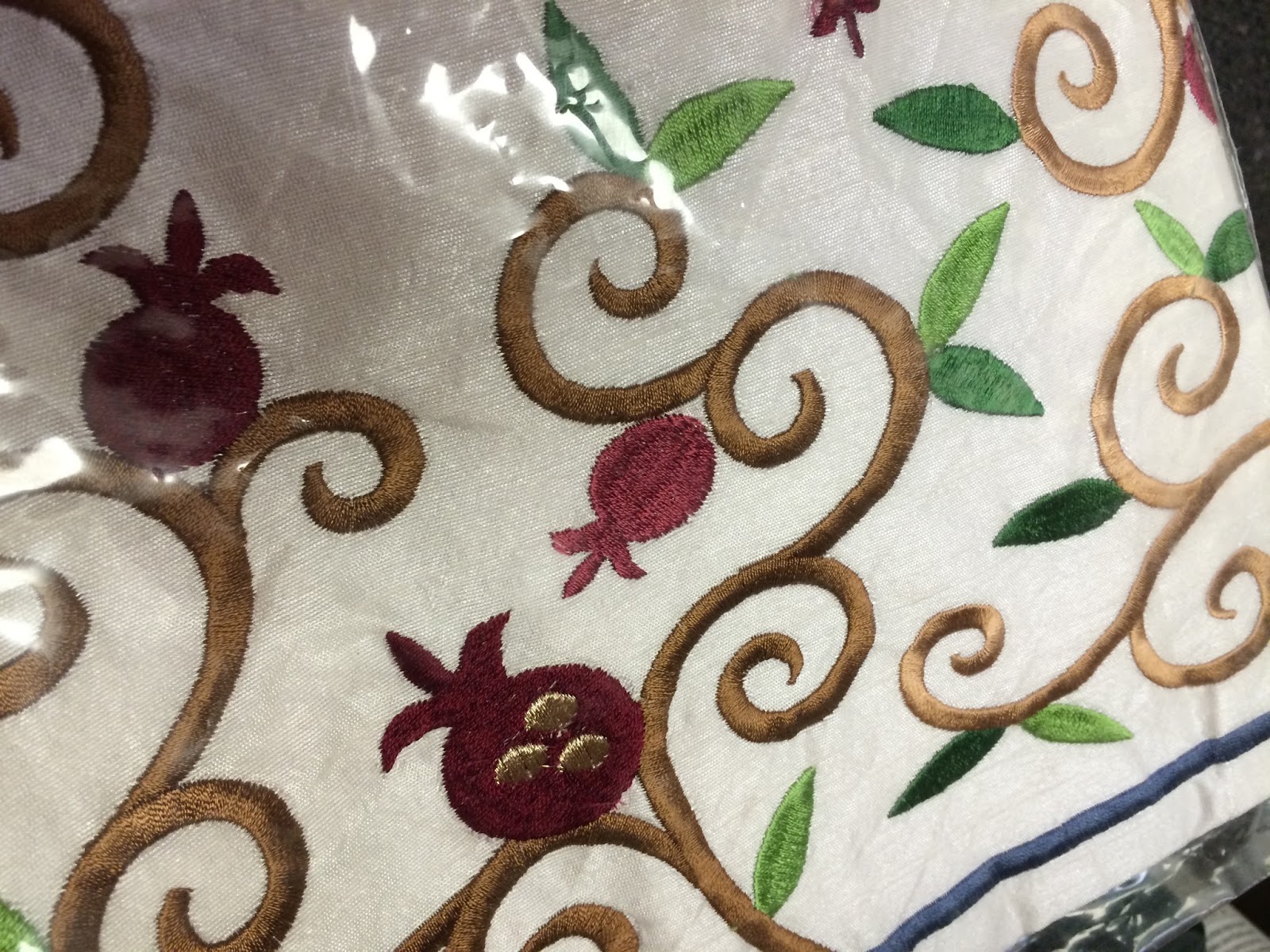
Yes, the pillow case is in its plastic cover -- until Passover!
I don't want to taint it with chametz.

This is a review and giveaway brought to you via me by the kind folks at JudaicaWebstore.com. The two items below -- a seder plate and Passover pillow case -- are valued at nearly $200, and I'm giving away this Passover package at the end of the post (it includes free shipping, too).


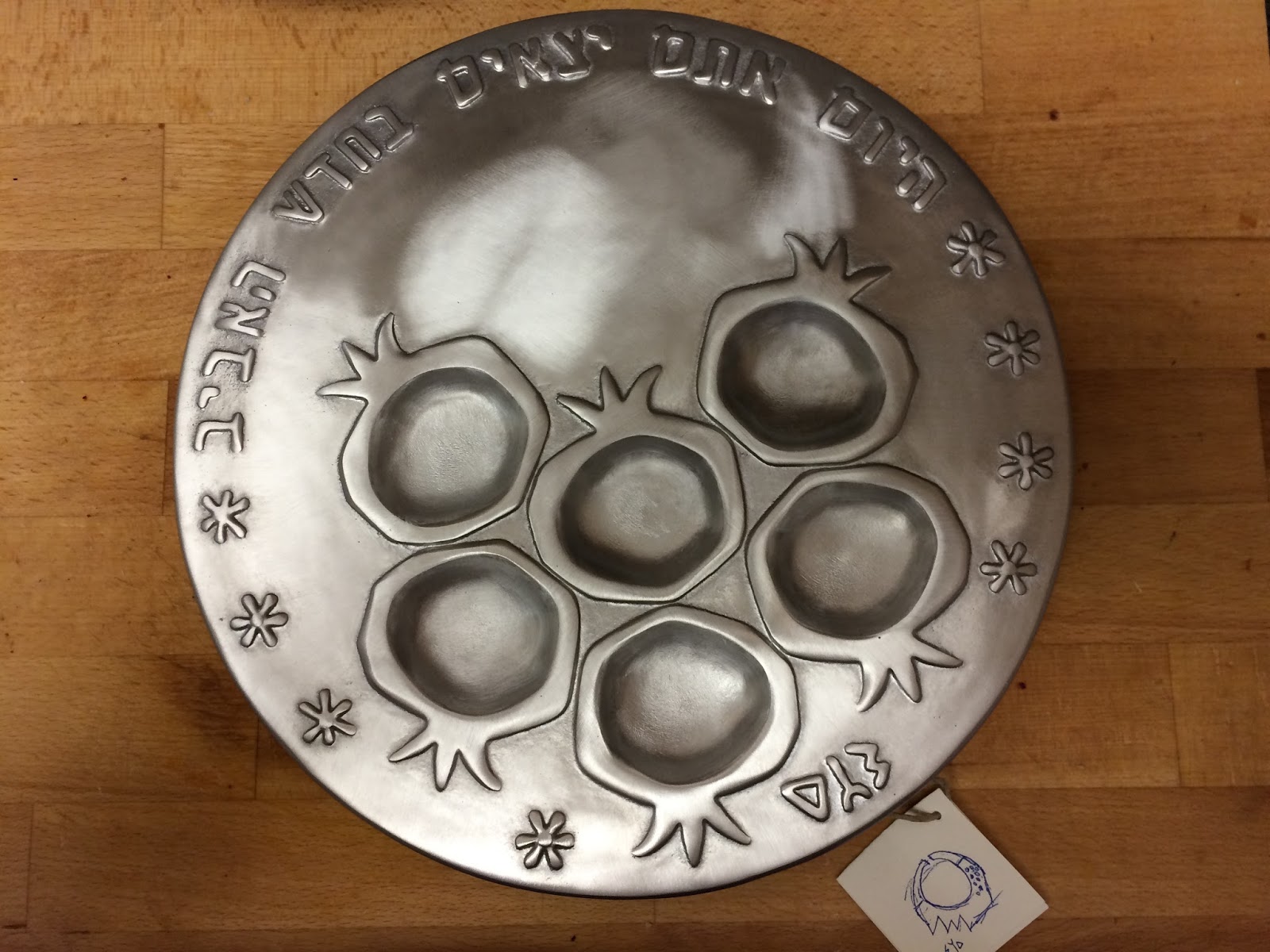
Shraga Landesman Seder Plate

Out of all the diverse, unique, and varied seder plates out there, Mr. T and I handpicked this beautiful, intricately formed cast aluminum number with a classic, yet modern pomegranate design that stands on four legs. I'm a sucker for pomegranates, and they grace just about every collection of holiday goodies I have in possession, from Shabbat to Passover and beyond. Check out that big spot to plop a shankbone, right?!

The Hebrew on this Shraga Landesman seder plate transliterates as "Ha'yom, ate yotzim b'hodesh aviv," or "Today, you go out in the month of Spring" from Exodus 13:4.

Love that detail! So pretty. 

Yair Emanuel Passover Seder Pillow

And then there's another tradition you might not know about, and that's the Passover pillow case. A lot of people make or embroider their own, and some even use the cute cases made by their kids in gan.

You see, every time we eat matzah or drink wine at the Passover seder, it's tradition to lean to the left upon a comfortable pillow. This act makes us feel like royalty, in contrast to the oppression of slavery suffered in Egypt before the Exodus. In some communities, only mean lean on comfy pillows, but I believe we should all be royal!

I'm a sucker for Yair Emanuel Judaica, and I have quite a few of his pieces in my home. You definitely have to recognize his work, as it's popular and everywhere. Classy, beautiful, and timeless, that's how I like my Judaica. This Passover pillow pulls some words from the haggadah: "Ha'lilah ha'zeh kulanu mesubin," or "On this night, we recline."

Ah, I love giving things away, and when I can handpick the beautiful Judaica you'll receive, it means all the more to me. Ready?

Again, this Passover Giveaway Package includes the Shraga Landesman Seder Plate, Yair Emanuel Passover Seder Pillow, and free shipping. The package is valued at nearly $200! The giveaway is only running for a week, so enter now!


a Rafflecopter giveaway

Tuesday, February 10, 2015

The Tzniut Project 2.0: Covering the Outside to Let the Inner Light Shine


This is the first in the Women's Edition of a series called The Tzniut Project 2.0. For the Women's Edition, women from a variety of backgrounds with a variety of observances have volunteered to anonymously answer questions that I have written about their practices, people's assumptions, and more. For more information on origins the project, click here

Please continue to check back with The Tzniut Project to read more stories and comment abundantly! For the Men's Edition, pop over here.

Note: This post is contributed by a reader in France whose first language is not English. I did my best to create clarity and provide translations where necessary, without detracting from the reader's original thoughts. 


1. How do you affiliate Jewishly? Feel free to elaborate on the words people use to describe you and the words you use to describe yourself. If you feel comfortable letting the audience know the city/region where you live, please include that, too. 
I am a granddaughter of a German Jew, but I am now currently living in France. It’s a difficult family story, my Grandma lost (or let disappear?) all the Jewish documents and survived the war by being hidden in an orphanage near [Nuremberg, Germany] and by being qualified as “Lutheran Evangelical” by an Lutheran pastor before the war. There are very good people everywhere.

But now this means that I have to make a formal giur (conversion) because of the lost documents. Strange situation, more than 70 years after the war: Being jewish but needing to convert to myself ... Well ... I am Jewish because I have Jewish blood and I come from a Jewish family, documents only will make it “official” but won’t change my personality. I am on my way to this, even if it’s very difficult. I am in an Orthodox shul (synagogue).

2. I say modesty or tzniut … what does that mean to you? 
It means being a Jewish princess for my dear husband! It means covering the body in order to preserve it for the most intimate relationship with the most important person in my life. It means covering the outside to let shine the inner light that G-d gave me. It means disagreeing with the actual “standards of fashion,” which uncover the body.

For me, covering my elbows, my knees, my collarbone and my hair is a “protest” against it, because uncovering the woman does not mean freedom, it means being a “prisoner from animal instincts," it makes the woman an object. I am telling the surrounding world that if they want to know me, they have to go a little bit further than just the outside. I am a soul that lives in a body, not a just body (feminism on this point!)!

3. Growing up, did your mother or grandmother (or any other female role models in your life) dress modestly in any way? Do you think modesty was something instilled in you by your family? Did you dress modestly growing up?
Yes, my mother was very careful in dressing us when we were children. There was no way we would wear miniskirts! Pants were not forbidden, but chosen so that there were not like “leggings." In fact, I think that some pants are more covering then skirts with a regular tzniut-length, but too tight! But for me, I don’t have pants any more because I chose it. I am wearing skirts and dresses, and I kept just a sport pant to go to the physiotherapist.

4. Are you married? How does your spouse feel about your choices for modest dress? Is it a dialogue or does your partner leave the mitzvah to you? 
Yes, I am married. My husband agrees with my tzniut-length dresses and is very proud of it because he feels [it makes him a] very special person: the one who has the privilege to “be mine” (Ani le dodi vedodi li -- "I am my beloved's and my beloved is mine.").

It’s not a matter of being proud, it’s a matter of love! He is very sweet and quite often goes shopping for me (because I don’t have so much time because of my job)! When he comes back with a skirt or a shirt, it’s my turn to feel very special, because I feel [sic] wearing clothes full of love and attention of my dearest one!

5. What do you wear on a typical day? On Shabbat? If you dress differently on weekdays and Shabbat, why do you make this distinction and how?
I am kind of a “positive gothic Jew." [Let me] explain: I [frequently wear] “Victorian gothic dresses." I love black lace everywhere! But [without] the skulls and other death-like elements (I have NOTHING like that, so that’s why I told that I am a “positive goth”). My favorite go-to combination:

A black pashmina tichel (head scarf) + red rose sash on black background + sparkling headband + red flower tichel pin or black lace tickle [with] matching earrings [and a] black victorian dress with a black shirt + grey tights with black roses and Doc Marten Vonda Boots! Perfect! Oh, I forgot: an antique-styled magen David (star of David) necklace. And soft gothic-like makeup.

On Shabbat? Quite the same without makeup (not on Shabbos!) Sometimes I switch to a white lace dress with colored shirts (yes it happens!). Then: matching tichels, pearls ... but I often can’t just quit my Doc Martens!

I guess the main difference [between Shabbat and the rest of the week] is: makeup during the week, no makeup during Shabbos. Maybe I wear more sparkling stuff during Shabbos (shimmery tichels and so on…).

6. What do you think other people (Jewish and non-Jewish) infer from your clothing and hair covering choices? Has anyone ever said anything to you outright that expresses a judgment based on your appearance? (Ex: “You don’t cover your hair or wear skirts, so why do you keep kosher?”). 
I keep tzniut and kosher, so no judgment based on this. Actually I received A LOT of compliments about my tichels from Jewish and non-Jewish people. I am a German teacher, [there is] no dress-code at school, and I am still a student: no dress-code here either. I have no fear about looking “other” than “regular fashion standards."

I am how I am, and as long as I stay within the tzniut-line, it’s ok. People who don’t like gothic style still respect my taste because it’s just me.

My credo: I have just one life to live. “Be yourself, everybody else is already taken!” Once I heard this quote, I felt free to express myself, and as long as I am not hurting anybody, it’s ok! That’s how I came out with my “positive gothic but still tzniut fashion”.

7. Have you ever surprised someone by dressing more or less modestly and making them rethink their stereotypes about what it means to be an observant Jew? 
Yes, of course, see the answer just above! I am the only one at shul like this! And yes, at shul, there are a few women that cover their hair just for Shabbos, but when they saw me with tichels on a daily base, they asked me where I learned to tie them. So I could give them some advice and YouTube videos, which were helpful to me. This was a great privilege for me!

8. When you see someone who observes tzniut differently than you, what are your initial thoughts? How do you deal with them? Is there any particular aspect of tzniut that you see other people observing or practicing that you struggle with? 
As long as it is tzniut, I am happy to find new ideas of style, of colour combinations that I can try myself! It makes me happy because it shows that tzniut is a wide concept in which everybody’s personality can fit in in terms of style and find a beautiful way to express the true “me”.

I particularly struggle with sheitels. I just can’t stand that principle, I actually never could, I have to be honest. First of all because I don’t understand the principle to hide your hair with someone’s [else's] hair: strange that I don’t show my hair so I show my neighbour’s one ... Even if it’s hair from India, our planet is so small that we are all neighbours! If it’s a synthetic sheitel, it may be less strange, but still ... Second because my sister had cancer (B"H she is fine now), but I saw her wearing a sheitel during chemo, which was the most difficult time I had in my life: to be at her side but not being able to take a little bit of pain from her. When I see a sheitel, I remember chemo, and it’s just too painful for me – but this is a personal reason I still have to overcome (even if I don’t judge women who wear sheitels because they are used to it, I am not here to try to convert anybody to “ticheling”!).

9. Please include any additional details or thoughts you have here. 
Tzniut is not a frame where you are not free to express yourself. [On the contrary,] it sets just some healthy limits on how much body to show. Keeping it covered makes it more beautiful. Showing too much makes the body depreciated, people think, "Oh, it’s just a piece of body more” [sic] and lose respect before you. Keeping it more “secret” has the consequence [of people looking] in your eyes, which are the windows to your soul, so tzniut is a channel that allows the inner “me” to come out much better!

It shows that a woman can dress beautifully with dignity. Don’t worry about what people will say, if you respect yourself, they will respect you. Tzniut, and especially tichels, make me a visible carrier of Jewish values. It gives me a huge responsibility because when people see me, they look at me and see a Jewish woman “in action."

This is a chance to spread light, love, and warmth to a world that needs it like never before. Even if it’s just a smile to somebody on the street. So don’t worry, be Jewish!

Monday, February 9, 2015

The Tzniut Project 2.0: Modesty Isn't a Physical Checklist

YES! It feels so good to be back in the swing of things with The Tzniut Project.

Big shocker here: The first installment of The Tzniut Project 2.0 comes from a man, and a Chassidic man living in Israel, no less. I've had gobs of inquiries and sent out the questions to many, so stay tuned for this exciting, fun, insightful series redux.


This is the first in the Men's Edition of a multi-part series called The Tzniut Project 2.0. For the Men's Edition, men from a variety of backgrounds with a variety of observances have volunteered to anonymously answer questions that I have written about their practices, people's assumptions, and more. In this particular post, I have tried to clarify Yiddish terminology and otherwise uncommon words through parenthetical statements and translations to the best of my ability to make the post accessible to individuals of every level of understanding and observance. Enjoy!


1. How do you affiliate Jewishly? 
Both my wife and I come from non-religious homes and today associate with the "Chassidic world" in Eretz Yisrael. We have a rebbe (teacher/mentor) and [follow] Chassidus, and we chose to send our children to Yiddish-speaking Chassidic schools. Our outlook and the Rabbonim (rabbis) from whom we learn and take our advice are Charedi (often translated as "ultra Orthodox" externally).

2. I say modesty or tzniut (also written tznius) … what does that mean to you? Do you think tzniut is a concept that is largely geared toward women?

Tznius is a requirement of Hakodesh Boruch Hu (G-d) for Klal (all of the nation of) Yisrael, both male and female equally. The concept of modesty has, of course, both internal and external aspects, yet it is only when the external are a manifestation of the deeply rooted internal understanding and acceptance of tznius that we truly serve HaShem through our modesty.

The Jewish people have a covenant with the Creator of the world. Our holiness and our greatness is guarded by furthering our understanding of HaShem and His Oneness. When we understand that HaShem rules over the world and there is no thought or action that He does not see, we understand that we must conduct ourselves according to His Torah and Will. However, when we understand the oneness of HaShem, and that every moment and every second of the day is an intimate experience of Him and a furthering of our relationship with him, then we understand how our thoughts, words and action impact this reality and this relationship.

Not one thought escapes HaShem; we are always bound up with him and always with Him — whether walking in the market or sitting in the shul. Walking to Shabbos services is as much an a avodah (task or activity) as participating in them because we are never seperate from HaShem.

Therefore, we see that every moment is special and our modesty is not limited to a physical checklist of elbows, knees, and what-have-you.

Modesty requires us to guard our thoughts from lewdness, to guard our eyes from immodesty, not to listen to foul language or lewd jokes — to be a holy and sacred nation unto HaShem Yisborach (may He be blessed).

[Blogger's Note: This is from this week's Torah portion, Yitro! How appropriate, albeit a few days after the fact.]

Not only that but when we consider the oneness of G-d and His constant involvement in the world, which he granted us, as a corridor to the next world, we begin to realise that our time is not our time, our thoughts are not our thoughts, our outfit is not our outfit — it is all granted to us, only to enable us to make the right decisions to come closer to G-d in this world and earn a place in the world to come.

3. Growing up, did your father or grandfather (or any other male role models in your life) dress modestly in any way? Do you think modesty was something instilled in you by your family?
I couldn't have lived in a less modest environment. My family were not actively immodest, yet secular society puts very little empthasis on the values of modesty and thus while people aren't actively pursuing immorality/immodest, it is all mixed in with daily life.

A friend down the street from us had an aunt who was a nun, she went with the whole levush (in Yiddish this refers to regimented dress) and none of us could get our head around such a young woman giving up everything for G-d and wearing such a funny outfit ... l'havdil (this word is about making a distinction), fast forward ten years [to us]!

4. Are you married? How does your spouse feel about your choices for modest dress? Is it a dialogue or does your partner leave the mitzvah to you?
My wife and I are both dedicated to upholding the Torah requirements of modesty in every way we can. If we ever come to a place of disagreement, we let the Rov (rabbi) be the final say — this can come about in how we dress the kids, for example. We both want emes (truth) — whatever the emes is, one of us will step down if we were mistaken.

5. What do you wear on a typical day? On Shabbat? If you dress differently on weekdays and Shabbat, why do you make this distinction and how?
I wear normal chassidic dress of a long black coat and hat. This in itself is an act of modesty that we all blend together, not one of us needing to stand out — becoming consumed in the oneness of HaShem. That doesn't mean we don't have individuality. Anyone that has experienced a frum (religious) community knows there is more personality there than anywhere else on earth, but the need to stand out is erased, and we blend in together, bustling along to serve HaShem day in and day out.

On Shabbos I wear a bekishe (long coat) and shtreimel (a special fur hat) l'kavod Shabbos (to honor Shabbat). 

My wife does not wear a sheitel (wig) and covers all of her hair either with turbans, snoods, or tichel (scarf, also called a mitpacha in Hebrew) depending on the occasion. My wife took on herself to wear tights with a minimum of 70 deniar (this refers to the thickness of the yarn/weave) that are not skin colored. These are common things in the charedi world, and she doesn't stand out from the norm.

6. What do you think other people (Jewish and non-Jewish) infer from your clothing and hair covering choices? Has anyone ever said anything to you outright that expresses a judgement based on your appearance? (Ex: “You wear a kippah, so you must be x, y, z.”)
We for sure get pigeonholed outside of the charedi world. One bonus of the beard and getup is that people often assume I don't speak English, so more often that not I get to hear what people really think of me in public (haha).

The truth is I don't wear anything to distinguish me to one group or another, and thus I get the charedi label.

More often that not we hear non-charedi chevreh (people) in the queue behind us ask such things as, "Do you think she shaves her head?" or "Isn't he HOT in that coat," in which case I normally turn around and ask for the time in a beautiful British accent, to ensure they don't stray into questions that could cause them embarrassment when one of us later answers the phone in English.

7. Have you ever surprised someone by dressing more or less modestly and making them rethink their stereotypes about what it means to be an observant Jew?

I think continuity is the key — one needs to make a true assessment as to what they believe is ratzon HaShem (the will of G-d) and then do that, even with great mesirus nefesh (self sacrifice) if necessary. For this reason I don't fluctuate up or down much.

8. When you see someone who observes tzniut differently than you, what are your initial thoughts? How do you deal with them? Is there any particular aspect of tzniut that you see other people observing or practicing that you struggle with?
Life is a journey, and the journey is a relationship with HaShem — if I know the person is actively having a relationship with HaShem, even though they may currently not be doing His ratzon (will) — I don't know their journey, I don't know their tests and problems in life. For this reason I try and stay away from judgement. However for my own observance of tznius, I also try and stay away from areas where I know there will be a lack of tznius.

Once by the kosel (Western Wall), my wife saw a Jewish woman arrive on Shabbos night, very "under dressed" (to say the least), carrying her iPhone and a pad of paper with a pen. She ripped off a piece of paper, wrote a kvittle (prayer), and stuck it in the wall (how many issurim [prohibitions] right there?!?) and then continued to daven (pray) with all her heart. 

Now it's easy to judge her — issur after issur (prohibition after prohibition). But it's also possible to see a Yiddisher neshama (Jewish soul) who gave up her Friday night to pray to G-d. We don't know what she has been through, what family HaShem had her born to, her Jewish education, etc. But we can see she gave up the Friday night bar for G-d. This is a relationship with HaShem. May it grow until she brings herself within side His ratzon (will).

9. Please include any additional details or thoughts you have here.
I truly believe that a thorough understanding of all the hashkofa and halochas of tznius (outlook and laws of modesty) are necessary for every man and woman. Then, one must spend significant time internalising them and turning them into a relationship with G-d.

The author of this post included some suggested reading (in English) for people that he believes is insightful and beneficial. Please note that I haven't personally read any of these books and thus do not endorse them, but from the looks of things they all can provide guidance, inspiration, and lessons on tzanua

Stay tuned for the next installment of The Tzniut Project 2.0. If you want to participate, just send me an email at kvetching dot editor at gmail dot com. If you have questions for the blog author, please post them in the comments section or email me them if you'd rather function on a private plane. 

Sunday, February 8, 2015

The Best Gluten-Free Challah Recipe You'll Find

Best-Ever Gluten-Free HaMotzi Challah Recipe

Nearly two years ago I posted up a few of the recipes I was relying on for making gluten-free hamotzi challah (meaning bread that I could wash and say a blessing on for Shabbat). I don't make or eat this bread during the week, because it'd be too expensive and time consuming, but for Shabbat it's important to have bread you can make a bracha (blessing) on. I've gone through a dozen different recipes, flour mixes, even trying Bob's Red Mill's new 1-for-1 gluten-free mix, all with terrible luck.

The facts:
  • For challah (or matzah for that matter) to be hamotzi, it needs to include at least 51 percent of one of the following grains: barley, wheat, oats, spelt, or rye. (See this Chabad.org article for their take on oat matzah.)
  • Gluten-free oats are those that are grown in dedicated fields and produced in dedicated facilities. (Traditionally, oats are grown in fields surrounded by wheat, creating cross contamination.)
  • Many people can't eat even gluten-free oats, despite the fact that it has been proven time and time again that the gluten in oats is not like that of barley, wheat, spelt (a type of wheat), and rye. 
  • Spelt is not gluten free. It is in the wheat family.
  • Gluten-free challah is, in my experience, unbraidable because the consistency of the dough is akin to cake batter, not traditional bread dough. For this reason, I recommend getting a mold you love, like the Kosher Cook's "challet" silicone pan, which is what I used for this recipe. 
And now, with our further ado, the recipe that I have been perfecting in my kitchen, that Asher prefers to regular challah and that was recently a hit at a friend's conference.

I've separated the recipe out in a way that makes sense to me. I like to see everything in parts -- ingredients (wet and dry), mixing, rising, and baking. It just makes more sense to me because then I can plan out how long things will take and what kind of attention I need. Ultimately, this recipe is very low fuss.

The Only Gluten-free Challah Recipe You'll Ever Need
Makes 4 challets

Ingredients: Get everything measured and mixed beforehand, lest your yeast/sugar mixture go crazy. 

For the Rise
  • 2¼ tsp dry yeast or 1 envelope
  • 1 tsp sugar
  • 1/4 cup warm water
Dry Ingredients
  • 2 1/4 cups GF oat flour (I grind my own)
  • ½ cup GF rice flour
  • ¼ cup GF potato starch
  • ¼ cup GF tapioca flour
  • 1½ tsp salt
  • 2 tsp xanthan gum
Wet Ingredients
  • 1/4 cup honey
  • ¼ cup canola oil
  • ½ cup almond milk
  • ½ cup warm water
  • 2 large eggs
For Baking
  • 1 egg yolk
Mixing (10 minutes)
  1. Preheat the oven to 200°F.
  2. Dissolve the teaspoon of sugar in the ¼ cup warm water. Add the yeast, mix well with a fork for about 15 seconds, and set aside until frothy, about 5 minutes.
  3. Measure and combine the dry ingredients in one bowl, getting rid of clumps. 
  4. Combine the honey, oil, milk, eggs, and warm water. 
  5. Pour the wet mixture into the dry mixture slowly and mix to combine. 
  6. Add the yeast mixture from the first step. 
  7. Mix well for 3-5 minutes (I do it all by hand, folks, but feel free to use your mixer). The mixture will be a little runny, but shouldn't be too runny. UPDATE: I found that using my KitchenAid and having it run with the whisk attachment for about five minutes got a lot of air in the dough, which made it rise better and it turned out to be much lighter and tastier as a result. 
  8. Turn the oven off. 
Rising (~ 2 hours)
  1. First Rise: Cover the dough bowl with parchment paper and leave in the warm (but off!) oven for about 1 hour or until the dough has doubled in size.
  2. Take the bowl out and turn the oven back on to preheat to 200°F.
  3. Stir the dough down and spoon into your lightly greased pans -- small loaf pans work, but I use the challet pan, and this recipe makes 4 challets.
  4. Turn the oven off.
  5. Second Rise: Cover the pan(s), return back to the warm (but off) oven, and let rise again for another 40 minutes or so, until the dough has doubled.
  6. Remove the rising challah from the oven. 
Baking (~ 30-35 minutes)
  1. Preheat oven to 375°F. 
  2. Part One: Bake uncovered at 375°F for 15 minutes.
  3. Line a cookie sheet with the parchment paper you used to cover the dough. 
  4. Remove pans from oven and invert half-baked loaves onto the cookie sheet. They should be solid at this point. 
  5. Lightly glaze loaves with the egg yolk, then return to oven.
  6. Part Two: Bake uncovered at 375°F for 15-20 minutes. You'll want the tops to have a nice, golden brown coloring. 
  7. Move to wire rack to cool.
Enjoy! Let me know if you have any trouble with this recipe. I edited it a million times to get it here. 

Thursday, February 5, 2015

The Tzniut Project: Version 2.0 is a Go!

The people have spoken: The Tzniut Project will return.

This project highlights views and experiences with modesty across the Jewish spectrum, from female Reform rabbis to haredi women in Israel and everything in between. Men are welcome to participate, too. In fact, I'd encourage men to participate.

I've considered setting up a form for entries, but I decided against it, because I want honest, legitimate individuals to participate. If you want to receive and answer the questions, please send me an email at chaviva at kvetchingeditor dot com and look out for an email with about 10-12 questions.

Your responses, when posted here on the blog (see the original The Tzniut Project) will be anonymous unless you prefer your first name and last initial to be attached to your answers.

In my experience, the response is overwhelming, so please be patient as I curate and edit the posts for posting.

I'm super excited to get started with this again.

Sunday, February 1, 2015

The Tzniut Project Redux?


While struggling with hair covering these days (hold on, I'm covering my hair, I just struggle with scarf versus wig), I started wondering whether it might be worth reviving The Tzniut Project. It was immensely successful when I originally ran the project, and I'd love to hear more from my readers and see if anything has changed over the past few years when it comes to modesty and how people are using and understanding the concept. 

What was The Tzniut Project? Basically people would email me and I'd send them a list of about 10 questions to answer at their leisure and I'd post their comments anonymously. The demographics were broad, and I even had a few men participate, which was fascinating. Ultimately I was surprised at how much our conceptions of modesty really scratch the surface and how "shallow" we approach the practice.

Interested? Let me know if you think I should bring it back and whether you'd be interested in participating by clicking here.

Also, I'd love to hop back into a fun and exciting feature that once ran the airwaves on this blog (and got kind of ugly): 


Also: Stay tuned here to the blog for THREE exciting reviews and giveaways in preparation of Purim and Passover (everyone needs new, pretty things, right?). 

Sunday, January 25, 2015

Book Review: Lashon HaKodesh: History, Holiness, and Hebrew

If I tell you that there's a book that is blowing my mind at every page turn, it means that you need to stop what you're doing, don't even read the rest of this post, and go out and buy the book. It's called Lashon HaKodesh: History, Holiness, and Hebrew, and I got the book as a review copy, but I would happily pay a few hundred bucks for this book. Why?

Okay, if you insist.

I'm only about 50 pages into this book about lashon hakodesh -- "holy language," also known as classic or biblical Hebrew or the language of prayer in Judaism -- but I've already uncovered a few fascinating things that have me poised for discovery. These will (hopefully) work themselves into much longer blog posts or articles over on About.com's Judaism page, but for now, let me blow your mind.

Aramaic

Did you know that there is an understanding of Aramaic as a language of mourning? You probably never thought about it, but ask yourself this: What language did Adam, the first human, speak? The rabbis toil over the topic, with my favorite theory being that Adam spoken lashon hakodesh in the Garden of Eden. After all lashon hakodesh was the language of G-d, right? What better language for Adam to speak? But what did he speak once he was booted from Gan Eden? Aramaic, evidently.

Lashon hakodesh became affiliated with the Land of Israel, with any use of Aramaic earning its user a negative outcome. Jacob, for example, agreed to a pact with Laban over an area that Jacob referred to in Hebrew but that Laban referred to in Aramaic. As a result, the rabbis say, Jacob was exiled to Egypt. Even Rachel suffered after she referred to her son in the Aramaic as Ben Oni (Jacob used the Hebrew, Binyamin or Benjamin), which earned her a swift death once she entered Israel. Yikes. Harsh! But thought-provoking, no?

I can't wait to explore this more. I have to hand it to Rabbi Reuven Chaim Klein for the intense and through footnotes and diversity of sources he has to offer on this topic (and others throughout the book, of course). My brain sparks are flying off in dozens of directions with every page turn.

Tower of Babel and Language Dispersion

The great thing about this book is that it provides unique perspectives on otherwise mundane aspects of language. Yes, the Tower of Babel is far from mundane, but how much have you really considered the language dispersion following the whole episode?

Think about it: The text says,
And they said, “Come, let us build ourselves a city, and a tower whose top is in the heavens; let us make a name for ourselves, lest we be scattered abroad over the face of the whole earth.” But the Lord came down to see the city and the tower which the sons of men had built. And the Lord said, “Indeed the people are one and they all have one language, and this is what they begin to do; now nothing that they propose to do will be withheld from them. Come, let Us go down and there confuse their language, that they may not understand one another’s speech.” So the Lord scattered them abroad from there over the face of all the earth, and they ceased building the city. Therefore its name is called Babel, because there the Lord confused the language of all the earth; and from there the Lord scattered them abroad over the face of all the earth.
There are so many theories and discussions about this by the rabbis, you'd be amazed. The ultimate discussion surrounds whether there was really one language prior to the Tower of Babel or if there was one shared language. You see, there is a classic understanding in Judaism that there were 70 nations, based on Noah's descendants. The rabbis go into a textual, cultural, and archaeological  discussion of whether there could be 70 languages at that point in time depending on where the descendants were. 

The two theories main approaches I like from Rabbi Klein's book: 
  • The people of the world spoke 70 languages prior to the Tower of Babel and when G-d confuses the language, he makes everyone forget 69 of the 70 languages they once knew. 
  • The people of the world spoke two languages prior to the Tower of Babel: one external (lashon hakodesh) and one internal. After Babel, the external language was lost and the people of the world only spoke their internal language and thus couldn't communicate. 
The killer discussion on whether there was one main language prior to the incident (lashon hakodesh) and other languages were created post-Babel involves an argument about whether G-d could even create new languages and whether that "creation" was actually creation or just evolving an already created aspect of life. The argument is based on King Solomon's "There is nothing new under the sun" statement in Kohelet 1:9. Genius! I can't wait to give this another go-round in my brain cage. 

Ah! I love it! This stuff takes me back to graduate school. Rabbi Klein has created a book that feels, to me, to be a perfect balance between the religious and the historical, the secular and the holy, in a completely accessible manner. 

I haven't been this excited about a book in a long time, folks. I've gotten a lot of books and a lot of them get read and passed over. Trust me: This one is completely and totally worth your time.

Also? The cover is pretty. So go buy it already

Friday, January 23, 2015

A Kosher Casual Review: Getting Comfy in a Raglan Top

I've been watching Kosher Casual for many years as they grew and expanded, and I was elated when I actually got to go to their store in Bet Shemesh. 

Kosher Casual seems to be the only shell purveyor that has the crop-top, sleeveless shell with a high-enough neckline. I attempted to pick some up from Halftee.com, but, unfortunately, the neckline just drops and drops throughout the day. So I'm experienced with Kosher Casual's shells, but I haven't really ventured into their clothing line, mostly because of my, let's say, physique. 


It's no secret that I'm a bit on the curvy side, and a lot of modest clothing websites don't cater to anything close to my size. I rely on stores like Old Navy, Target, Ross, and TJ Maxx for tops, not to mention Lane Bryant (when I feel like going broke) and Lands End for skirts and other accoutrements.

When I was approached by the kind folks at Kosher Casual to pursue their new, sleek (no seriously, and it's not just because the homepage graphic features my purple IKEA couch) website and see if there's anything that fits the bill for review, I was hesitant. 

I immediately looked for a Plus Size section, then looked over the size charts. Nothing from the waist down was meant for me at Kosher Casual, which makes me sad. The amount of times I've gone into an Isreali skirt shop and struggled to find a skirt in my size (because the shop owners like to peg your size, and let's just say everyone thinks I'm smaller than I am) is depressing. Unfortunately, Kosher Casual still isn't on the plus-size skirt game, which has huge huge huge opportunity in Israel. 

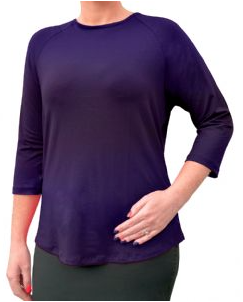
I moved on to the tops, knowing that I can wear their shells, and opted for the Loose-Fitting Raglan Shirt with a 3/4-Length Sleeve in Dark Purple. Then poof the shirt showed up at my apartment and I have to say, I love it, with the exception of the seams. 

The shirt has a sort of baseball t-shirt look, and because it's all one color it means that it looks a little strange, meaning I wouldn't wear this purple shirt without something over it like a cardigan or jacket. Okay, now that I'm writing it and thinking about it, I'll probably wear this shirt without a cardigan in the dead of summer and it'll be super, crazy comfortable, not to mention airy. 

It's incredibly comfortable (am I wearing a shirt?), and the fabric is very forgiving. The color, too, is beautiful. I might just have to order every color, because the neck is the right amount of modest and the sleeves hit in the perfect spot and are not binding, either. 

Although there isn't much in the way of plus size fashion at Kosher Casual, they have some essentials that are simply perfect, and basics can go a very, very long way when it comes to modest fashion. The company is owned and managed by an American immigrant to Israel, Gary Swickley, and I can't say enough about a company that is committed to its production staying in Israel. When you can, support Israeli companies, people!

If you want to enjoy some of the casual and comfy fashion from Kosher Casual, enter their bi-monthly raffle to win a $50 Kosher Casual gift certificate! The next drawing will be on January 31, 2015. 

Note: I wanted to post pictures of myself in this shirt, and I will, but since we've both been sick all week, the shirt got used as a kleenex by my 1 year old. TMI? :)

Friday, January 16, 2015

The Na Nach Bumper Sticker: A Missed Connection

נַ נַחְ נַחְמָ נַחְמָן מְאוּמַן

A stop in to Trader Joe's today to pick up some veggies and fruit (the kid loves pomegranate seeds and cucumbers these days) left me feeling like I'd missed an opportunity. A Jewish opportunity.

As Ash and I got out to the car with our groceries, a well-coifed woman with white hair approached me as if out of nowhere, asking me what the bumper sticker on the back of my car meant.

I was stunned, because in all the time we've had that bumper sticker (that's really a sticker on a magnet, because, you know, resale value), I've never had anyone ask me what it meant. Likewise, in all the time it's been there, especially since Mr. T has been gone, I haven't thought much about it being there.

"Well," I stammered, "it's in Hebrew. It says ..." and I trailed off with the Hebrew, explaining that it's all about Rebbe Nachman of Breslov and that it's my husband's thing.

"He's the Lubavitcher, right?" she asked, as a scruffy man shuffled up beside her.

"Oh no," I responded. "This is Breslov, it's like Lubavitch because they're both Hasidic, but different."

"Oh I see," she said. "So what does it mean?"

I was a bit stunned again. I read the Hebrew off, but I forgot what it all meant. The flames in the classic "logo" of Rebbe Nachman spell out "Ha'Aish Sheli," or my fire (from the petek). I related that to her, but the conversation sort of ended there.

As they walked away, the scruffy man threw up his arms in frustration and shouted to the sky, "And I come from a line of Chasidim!"

It appeared to me that, here was a man who clearly had a history that he didn't understand and here was a woman (his wife?) who clearly had a curiosity. And my response to this man, in his expression of frustration or perplexity?

"It happens!" I said.

The woman wished me a Shabbat Shalom, they got in their old, white boat out of a 1970s cop drama and drove away.

The whole way home I considered how I could have handled the situation differently. Was it an attempt for someone to connect to Judaism through me? Was it an attempt to get me to connect to my own Judaism more deeply?

The fact that I couldn't easily explain the meaning of the Na Nach sticker on the back of my car probably points to an issue. It's always been Mr. T's thing, not mine. He reads Likutei Moharan, not me. He knows the petek inside and out, not me.

Was the missed connection for me or about me?

Tuesday, January 13, 2015

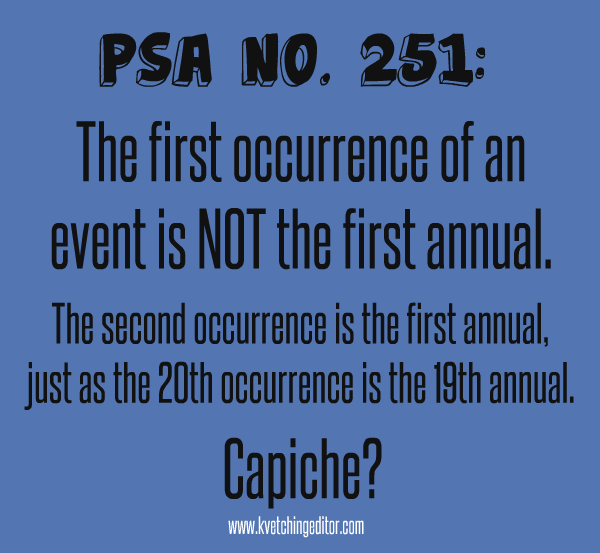
A Grammar Break: The Apostrophe Rule and the First Annual Rule

Once upon a time my life was wholly devoted to copy editing. I spent four years on a copy desk in college at a Student Pulitzer Prize-winning newspaper, I interned with the prestigious Dow Jones News Fund at The Denver Post, and I interned and was hired on as a copy editor with The Washington Post (yes, that Washington Post).

Those were the days. The days when I thought I'd be a newspaper girl forever. Unfortunately, those days died with the reality of working from 4 p.m. to midnight while living in a 9-5 uber transient city (Washington D.C.). The two were a terrible match, and I left life as a professional copy editor for good.

These days, I'm mostly a writer. Last night I pumped out 1,000 words in two hours for a website focused solely on Super Bowl ads (I'll admit it was one of the easiest, most fun articles I've written to date). I've written about the Small Business Administration, the website-building platform Wix, Game of Thrones, and, of course, a boatload of articles over on About.com.

Now that I'm mostly in the marketing and content writing game, however, I'm realizing just how bad the world of copy editing and editing in general has become. The amount of silly errors I see in nicely printed materials makes me want to cry. So I've decided to do the world a bit of a favor and provide some fun, sharable graphics with basic grammar rules that are easy to pick up on and use, use, use until the phrase "well, everybody does it that way, so it's okay now" disappears from the atmosphere.

Here are two for today:


Share them, pin them, send them to your company or organization's marketing department or editing desk, and let's change the world — one apostrophe at a time!

Monday, January 12, 2015

Haveil Havalim: The Je Suis Juif Edition


It's still Sunday here in Denver, which means it's the wee hours of the morning in Israel, so I have to apologize to the individuals waiting to see this live on Sunday; it's still Sunday here, so that works, right?

When I mentioned on social media that I was hosting the newest installment of Haveil Havalim, the bulk of reactions from long-time friends and bloggers was a resounding, "Wait, that's still a thing?" Yes, yes it is. I'll admit I haven't hosted since January 2012, and back then I used to host fairly regularly. Back in the day, every Haveil Havalim installment was numbered, which was awesome because you knew where you stood. Three years ago when I hosted, we were on No. 343, so that'll give you some perspective.

What is Haveil Havalim, you ask?
Founded by Soccer Dad many years ago, Haveil Havalim is a carnival of Jewish blogs — a weekly collection of Jewish and Israeli blog highlights, tidbits, and points of interest collected from blogs all around the world. It’s hosted by different bloggers each week and used to be coordinated by Jack and is now coordinated on Facebook. The term "Haveil Havalim," which means “Vanity of Vanities,” is from Qoheleth, (Ecclesiastes) which was written by King Solomon. King Solomon built the Holy Temple in Jerusalem and later on got all bogged down in materialism and other "excesses" and realized that it was nothing but "hevel," or in English, "vanity."
If you want to participate or, better yet, host, visit the Facebook group, join, and stay up to date on where to send your weekly entries. If you have a Jewish/Judaism/Israel-related post from the past week that you love and think is worth sharing, feel free to post it in the comments. 

About half of these were sent in, and there were a few that were sent in that I didn't post for my own personal reasons. The other half I found on my own because, darn't, Haveil Havalim used to have diversity, substance, and quality posts from across the blogosphere!

Judaism/Torah/Halacha (Jewish Law)

Ben-zion offers a most poignant (for me anyway) tidbit on the importance and power of persistence. I highly suggest you read this one, folks. 

I posted a week ago about the laws and leniences when it comes to carrying on Shabbat, mostly for the mommies out there. 

I really loved "How Orthodox Judaism's Laws of Modesty Gave Me a Sense of Style" on Vogue by Michelle Honig. Not only did it provide a vehicle for education about modesty within Orthodox Judaism, but it was super, super tasteful, concise, and well-written. 

The Rebbetzin's Husband shares some topics and questions on Treating Diabetes on Shabbat. Here's hoping there's a followup with the answers to those questions!

From Divrei Chaim, an interesting blueprint for geulah (redemption) based on the past week's Torah portion (Shemot). 

From Beyond Yeshiva comes what I'll call a PSA for life in Israel in Growing in Eretz Yisroel

The question "Why Orthodoxy?" is at the front of Life in the Married Lane's author in her most recent post. 

Israel

Batya offers a concise, personal review of Akiva Teddy MacLeod's Welcome Home: My First Six Months Living in Israel, as well as a peek into her cold weather prep

Speaking of cold weather, Miriam asks (and then answers) what one should do on a chilly day in Israel (lucky you, it involves food). It's All From HaShem also ponders the cold weather, acknowledging that, ultimately, it's all up to HaShem (as her blog title suggests!). Meanwhile, over at Our Shiputzim, the impending cold weather inspired a post-Chanukah post

Over at Adventures in Aliyahland, you might be surprised to discover Israel's best kept secret (and no, it's not a falafel stand). 

You can read a Tale of Two Arab Women, Anett Haskia versus Hanin Zoabi over at Shiloh Musings.


This post is dedicated to the memory of these four men who all dreamed of a life in Israel in one form or another. They all died in France in a senseless act of blatant Jew hatred. 

Like all parents, I'm sure, I'm terrified of the world my child will grow up in. However, it is mostly because he is a Jew and Israeli. He will grow up irrationally hated by other children who grew up with an education based on lies, murder, and hatred. He will grow up in a world that wants him dead at all costs.

On the other hand, maybe something will change. Maybe the world will wake up. Maybe he will grow up in a world that sees the merits of his humanity. Maybe.

NOTE: Send posts for next week's Haveil Havalim to shilohmuse@gmail.com

Sunday, January 4, 2015

Woe is Me! Carrying Asher on Shabbat

A few weeks ago the eruv was down and I was in a panic. I contacted the local rabbi to ask if there were any leniences about carrying Asher to synagogue, especially considering I live so, so, obnoxiously close to the synagogue. Hold on. I'm getting ahead of myself here, right?

Lowdy, Lowdy, that is a huge eruv!

You see, the eruv in plainest terms is a "boundary" that is set up to allow Jews to carry from the private to the public domain on Shabbat. Yes, "carrying" is one of the 39 forbidden melachot, or types of work, on Shabbat. Jews are forbidden from carrying from a private domain (like the home) into the public domain (outside, for example) or more than 6 feet (that's four amot) while in that public domain.

So, for example, if there's no eruv set up, I can't leave my apartment complex carrying a bottle of wine or a bag or even a Kleenex. Nothing, nada, zip.

For men, the essential items for Shabbat like the tallit (prayer shawl) are easily worn to synagogue from the home, so there's no need for concern there. But when it comes to women and children, without an eruv you're basically stuck at home until your children can walk the distance to synagogue on their own and don't require a sippy cup or anything that can't be "worn." Ugh.

The truth is, carrying in the public domain wasn't a problem for much of history because Jewish communities lived in small, tight-knit communities that were walled, making the entire area "private."

In the genius of the Jewish people, the eruv was created to allow for carrying in the public domain. The modern eruv, then, uses wires that typically hang from light poles and the like around a Jewish neighborhood to create a large private domain. Yes, it feels like a loop hole and a bit of a cheat, and this is probably why quite a few Jewish communities simply don't use or accept the concept of an eruv (think: the Lower East Side of NYC).

Okay, now that all of that is out of the way, back to the issue.

It snowed, so part of the eruv got knocked down and it couldn't be fixed because of the weather, so Asher and I stayed indoors because the rabbi's solution was to find a non-Jew to push the stroller (and I don't know any non-Jews in these parts).

So I got to thinking. I chatted with some other parents and we were all trying to figure out what the actual issue is, especially in light of the concept of "Chai Noseh Es Atzmo" -- a living being carries itself. According to the Tosefot, at the time of the building of the Mishkan, from where we get the 39 melachot, this wasn't even an issue (a person carrying another person), so technically it doesn't fall in the category of carrying as a prohibition.

However, as it turns out, the principle of "Chai Noseh Es Atzmo" is only applicable when the person is able to walk on his own, so it doesn't apply to an individual who can't "carry" himself or herself. Thus you can't carry a child (or drag a child who refuses to walk) who is not able to carry himself, lest you violate the rabbinic prohibition of carrying. On that note, it must be noted that this isn't a biblical prohibition.

To that end, Rabbi Moshe Feinstein suggested that carrying a living organism (like a baby) is only prohibited when it is evident that the "item" had been transported. Since people see Asher walking, I suppose no one would assume he was carried to synagogue on Shabbat if the eruv was down, right?

Unfortunately, Mishnah Berurah and the greater Jewish world hold very simply that carrying a child on Shabbat is prohibited. No conversation about it. So what to do?

A child who is capable of taking steps can be walked, even if you have to assist the child in doing so. It also would seem that if you're in a rural or suburban area and the child falls and refuses to get up and walk, you are allowed to carry the child home. If you're in a big city, however, you don't get off so easy and you have to figure out a creative way to get the child home or let him cry it out on the sidewalk until a non-Jew comes by.

There does seem to be a leniency when it comes to carrying for 6 feet, however. By this account, I would think that I could theoretically carry Asher for 6 feet, put him down and let him walk a bit until he falls, carry him another 6 feet, and so on. Right?

Anyhow, luckily this week the eruv got put back up before Shabbat, saving us from imminent doom of being inside for a full 25 hours alone. Together. Head explosion! At least he's cute, right? (Insert smiley here.)

How do you handle life without an eruv? I'd love to hear any and all rants about the concept of the eruv from everyone -- Jewish or not. What do you think about it? .

Wednesday, December 31, 2014

Packing Away the Losses and Looking Forward

All roads have led us here. 

I've always been a big believer in the "no regrets" philosophy on life. I like to think that everything happens for a reason (cliche), that the big dude upstairs never gives us more than we can handle (Jewish cliche), and that no matter how craptastic everything in life seems, gam zu l'tovah (religious Jewish cliche).

On this point, a friend sent me a video of Oprah talking about how there are no mistakes, that all paths and decisions lead to the same point, a greater destiny in time that we can't always see or envision or understand, but that all of our choices, good and bad, land us at that same destination. I'm not an Oprah-holic, but she has a very good point appropriate for both a new year and my life right now:
"There is a supreme moment of destiny calling on your life. Your job is to feel that, hear that, and know that. And sometimes when you're not listening you get taken off track. ... but it's all leading to the same path. There are no wrong paths. There are none. There is no such thing as failure, really. Failure is just that thing trying to move you in another direction, so you get as much from your losses as you do from your victories. Because the losses are there to wake you up."
The other day the local afternoon radio show was doing a segment where they were asking callers what, if anything, they would hop in a time machine and go back and change. There were all sorts of stories, from people cheating with their best friend's significant others to not taking amazing job opportunities and losing out on millions and millions of dollars. I started racking my brain about the choices I've made in life and trying to decide what I would go back and change.

I thought about the moment I decided to stop working for The Washington Post. A dream job, my friends said. People would have killed for my job at The Washington Post. Should I have stayed? Should I have found a way to make the hours and loneliness work? Where would I be now had I stuck it out? My dream was always to live in New York City and work at The New York Times, and maybe that dream would have become a reality. I had connections, I had the skill.

I thought about the moment I decided to really end things with a long-term boyfriend, a boyfriend with whom I held an epic love story of distance and years and drama. What if I had stuck around in Chicago instead of leaving to go to graduate school, what if I had made a commitment to be there for the one-millionith incarnation of our relationship? I had loved him, I knew him, I'd committed years to us.

Oddly enough, those are the only two moments in my life that popped up as possible "go back and change it" moments. And in that same instance of momentary thoughts I considered my son, my husband, my Judaism, who I am now.

Had either of those moments in my life not occurred precisely as they were meant to, no matter how much heartache, pain, and fleeting regret I have about them, I would not be where I am today. I would  probably not be an Orthodox Jewish mother to a beautiful little dreamboat of a boy or a committed wife to a husband a million miles away doing everything in my power to keep our world afloat.

I've had a lot of losses this year. I could enumerate them month by month for you, but that would be a labor of looking back, not forward.

I want to focus on waking up, not the losses. This year's wake-up call is propelling me into 2015 with a sense of commitment to my marriage and my son, to knowing that my father is in the right place for him, to solidifying a plan to return to the land where I feel so at ease even when I understand nothing I read or hear, and to feeling more alive and trusting in my Judaism.

After five years of doing Jewish (I finalized my Orthodox conversion on January 1, 2010), I think I can handle this.

Here's to 2015, everyone!

Friday, December 26, 2014

10 Days Will Never Be Enough

At Ben Gurion, prior to departure.

I'm the woman you'll find booking it between Terminal C and the International Gates at the Philadelphia Airport with puffy red eyes and tears streaming down her face. Twice. Coming and going, I broke down, Asher happily eating cheerios and staring at the shops flying by and people asking if I'm okay, as I flew through the airport trying to make connections, barely, both times.

And after 10 days in Israel with my husband (and the difficult last-minute decision whether to possibly cancel the trip because of health issues with my father), who I hadn't seen in 2.5 months and won't see for another 2.5 or more months, after the second breakdown in the airport after leaving him at Ben Gurion and the 12-hour flight with a 1-year-old child and the never-ending customs line and having to pick up and then recheck my luggage and stand in security and have a TSA agent yell at me for throwing my shoes at her because I was frustrated that I had to completely dismantle my entire stroller unlike I had at any other airport, after it all and I was sitting back in my car in Denver heading back to our apartment where all our stuff is and where Ash immediately fell back into his circuit of toys here, toys there ... I realized how utterly broken I am.

I find myself perpetually on the verge of tears. Those moments where things are quiet and calm where my mind is relaxed I remember my reality, the reality of those around me, my family, my father, my husband. It all breaks my heart. And it's exhausting.

There's a popular joke that Jewish guilt is a special form of torture. Although I wasn't born Jewish, I was clearly born with a Jewish neshama (soul), because the moment the plane rose into the sky over Tel Aviv all I could think was, "I didn't tell him I loved him enough or hug him enough. I didn't do enough while I was there."

I also found myself walking through the Philadelphia airport today whispering to myself, "What did I do HaShem? What did I do to deserve this?"

After I got divorced (or maybe while), I read Harold Kushner's Why Bad Things Happen to Good People, and part of me is thinking I should crack that puppy back open. I remember having more clarity and understanding of the pain I was feeling and feeling better about the cause-and-affect reality of Judaism.

Without a doubt this has all been one mighty test. It will continue to be a test until we're all back together again. The verge-of-tears reality over those far away and those close by will continue, the frustrations with not having a night to myself will continue, and the pain of feeling alone, helpless, and lonely will persist.

My world is a mess. As usual. Right? Calm is not in the books for me.

Luckily, as everyone along my journey to and from Israel told me, my son is beautiful and happy, evidently I'm a natural mother, and with those things combined, I have a bit of hope that we'll survive. That I'll survive.

I just have to figure out what that means.

Wednesday, December 10, 2014

Review: Maccabee on the Mantel, Mensch on the Bench, and Gelt-Giving Golem

Captain makes a guest appearance with the Chanukah crew.

My house is full of cute plush creatures and their tales of Chanukah miracles and Asher couldn't be happier!

Yes, we're the proud owners (thanks to receiving these for review) of the Gelt-Giving Golem, Mensch on a Bench, and Maccabee on the Mantel. Each of these plush cuties comes with a box and a book that tells a bit about the Chanukah story, a bit about the character, and a bit about the celebration, the brochot (blessings), and how-tos when it comes to the eight day festival. Likewise, all three encourage the new owner to give a unique and special name to the Golem, Mensch, or Maccabee.

The three are very different in terms of what they bring to the table for the discerning, gift-giver. I always say that I'm boldly honest when it comes to my reviews, and I won't hesitate with that promise here.

Mensch on a Bench (✡✡✡)

You've probably seen the Mensch on a Bench in your local Target or Bed, Bath, and Beyond, as it's the most well-advertised in the mainstream. It's also probably the most substantial "kit" out of the three, as it comes with a mensch decked out in a black hat, tallit, and beard; a book about how to be a mensch (a generally good person); and a removable bench for his lounging pleasure. The mensch holds the shamash (that's the candle that you use to light the other candles on the Chanukah menorah) at the ready for each night of Chanukah, and I love that you're urged not to actually let the mensch light your menorah.

I really like the idea behind this kit, and the plush mensch has a super expressive face (we named him Mordechai) and a well-thought-out outfit and brand. Of the three, however, it isn't Asher's favorite.

The Gelt-Giving Golem (✡✡)

The first company that contacted me presented the Gelt-Giving Golem, the concept for which I really liked. According to the website, this kit
"tells the tale of the Hanukkah Golem, a friendly character who was formed from clay by Rabbi Ben Bezalel on the 25th of Kislev, the first night of Hanukkah. The Hanukkah Golem teaches children to practice Tikun O'lam (repair of the world) and shares chocolate gelt with children who are well-behaved during the holiday."
In this sense, its theme is the closest to the popular Elf on the Shelf, what with the Golem geared toward overnight antics and the promise of treats.

I will say that the plush is not very impressive (especially compared to the other two), although he does have velcro on his hands and feet so you can easily attach him to things in your home. If anything, Asher really loves that the Golem has a cape, because we can make him fly. Even still, he's not Ash's favorite!

The Maccabee on the Mantel (✡✡✡✡✡)

Of all three of these Chanukah-themed boxes of meaning, inspiration, and fun, this is Asher's favorite by far. It is the most substantial and high-quality of the three when it comes to the packaging and presentation, with its almost anime-style illustrations in its book, and the plush itself is very light and soft in its features, which seem to really appeal to my little one.

I also think The Maccabee on the Mantel provides the nicest tie-in to Chanukah overall, what with the plush and almost squishy-soft/hard-cover book highlighting the miracle of Chanukah and the role of the Maccabees. Of the three, it seems like it's the most true to the message of Chanukah.

Asher schleps Zevulon (that's what we named our Maccabee) around the house with joy and giggles, and I have to say that if I had to pick one of the three to gift, I'd definitely pick this one. They also have a lot of really cute videos:


Note: I have a bunch of pictures of Asher + the Chanukah crew and how he reacted when we received them and opened each of them, but I have to find them to post. When we opened Maccabee on the Mantel it was almost like the Maccabee walked out of the box! His jaw dropped and he did this sort of "air release" sound. It was freakin' adorable.