Spraying Air Freshener: Despite the superficial resemblance to zeriyah, it is permitted to spray air freshener on Shabbos, since the air does not take part in dispersing the spray. (Minchas Yitzchak, 6:26).I'm not kidding. I turned the page and there it was. Minutes, nay seconds, after I'd posed the question. These are the kinds of things that freak me out, make me smile, and give me hope.
Sunday, February 22, 2009
G-d will provide, eh?
Just an interesting quip: Sitting at home during Shabbos today, I was reading the book that I received over Chanukah on the 39 Melachos. I got up from the couch, used the little girl's room, and in the process reached for the air freshener, and while spraying it, thought "I wonder if it's kosher to spray air freshener on Shabbos?" I washed my hands, nearly shut off the bathroom light (saved!) and then went back to the couch. I snuggled up with Tuvia's Patriots blanket, picked up the book, and kept reading where I left off, which as it turned out required the turn of the page. And there, at the top of the page -- and the only thing on the page -- was the following:

Good Riddance!
I hope everyone had a meaningful and restful Shabbos. This was my first Shabbos with the Artscroll Ohel Sarah in-hand, and I couldn't be happier with it. It's really the ultimate siddur for a gal like me, so mad props to Susanne for being awesome and having her's so it could be brought to my attention. As for the Shabbat itself? Well, it left a lot to be desired, but I don't want to dwell on it, so we'll move on.
Instead, we'll talk about some BIG NEWS for me that isn't Jewishly related*, but is a big thing for me. It's pretty personal, but I'm a full-exposure kind of person. So, folks, for the first time since 2001, I am debt free (except for student loans, but even those? I don't have as many as some in my position).
I got my first credit card, a Visa, my junior year of high school when I was 17. My concert choir was going to New York City for a choir competition and we were going to be there for four or five days wining (not so much) and dining, visiting Ellis Island, going to a Broadway Show, you name it. I was working part-time at an in-bound catalog call center, but I wasn't making much money. I had to pay for the trip all by myself, but when I was done I had no spending money. So, the parents suggested I get a credit card (sage advice ...), and I did. I managed to get my first credit card as a junior in high school with no co-signer needed. Why? Well, I'd been working for several years, so I had legitimate work experience, and I'd had a bank account for many years, too. So I got the card that had a $500 limit on it and went on my way. From that point? People borrowed the card, I got more cards, I kept getting credit at all sorts of places -- JCPenny's, Best Buy (though these two I never really used), a MasterCard, another Visa ... when I was done, in the past eight years, I managed to have more credit and credit cards than I could possibly handle. Being in school, I used the cards as a crutch (the downfall of most college students with no guidance on credit) and ended up maxing a few out, and making payments became a dreaded situation.
I can remember one month, my senior year of college where I had to sell DVDs and CDs, not to mention some much-loved books, in order to pay my rent because my paycheck went to pay credit card bills. When I think back on it all, I don't even know what I bought with my credit cards. Books, clothes, food, alcohol? Just things.
Since graduating, I had spent a great deal of time hoping, magically, that all of my debt would pay itself off. It never happened, but I continued to work hard, save money, and through a couple of years of trying, I managed to pay it off, without going completely broke. Now, I know what a lot of you are thinking -- why share such a personal bit of information? You know, the thing of it is, I know there are a lot -- A LOT -- of people out there with credit card debt. Maybe not my readers, but it's a big problem, especially now. To know that in such a crappy economy that I can pay off my debt, tells me that financial stuff is always fixable. There has to be a will, and where there is a will, there's a way. And the one thing I wanted was to pay off all my debt so that I wouldn't feel so bogged down while in school and so that someday (G-d willing) when I'm married I can start it all off with a clean slate.
So, I feel good, despite all the Shabbos drek. I feel like a weight is off my shoulders, but I also keep telling myself in the back of my mind that "debt free" does not mean that I can start charging up my cards again. Instead? It tells me that if (G-d forbid) something should happen, I have a cushion. Otherwise? I need to spend within my means, and that, folks, is what I'm starting to do. The only things I need these days are: Judaica books, siddurim (can't have too many!), skirts, kosher food, and a little extra cash to buy Shabbos flowers and things like that. The books are one habit I'm not willing to skimp on ...
Shavua tov, readers!
* I'm a firm believer that to be a successful blogger (and this is just the Chavi philosophy), one should pick a topic (in this case Judaism/Jewish things) and write about it 93 percent of the time. The other 7 percent is alloted to random things, personal quips, YouTube videos, and things like this entry here.
Instead, we'll talk about some BIG NEWS for me that isn't Jewishly related*, but is a big thing for me. It's pretty personal, but I'm a full-exposure kind of person. So, folks, for the first time since 2001, I am debt free (except for student loans, but even those? I don't have as many as some in my position).
*crowd cheers!*
I got my first credit card, a Visa, my junior year of high school when I was 17. My concert choir was going to New York City for a choir competition and we were going to be there for four or five days wining (not so much) and dining, visiting Ellis Island, going to a Broadway Show, you name it. I was working part-time at an in-bound catalog call center, but I wasn't making much money. I had to pay for the trip all by myself, but when I was done I had no spending money. So, the parents suggested I get a credit card (sage advice ...), and I did. I managed to get my first credit card as a junior in high school with no co-signer needed. Why? Well, I'd been working for several years, so I had legitimate work experience, and I'd had a bank account for many years, too. So I got the card that had a $500 limit on it and went on my way. From that point? People borrowed the card, I got more cards, I kept getting credit at all sorts of places -- JCPenny's, Best Buy (though these two I never really used), a MasterCard, another Visa ... when I was done, in the past eight years, I managed to have more credit and credit cards than I could possibly handle. Being in school, I used the cards as a crutch (the downfall of most college students with no guidance on credit) and ended up maxing a few out, and making payments became a dreaded situation.
I can remember one month, my senior year of college where I had to sell DVDs and CDs, not to mention some much-loved books, in order to pay my rent because my paycheck went to pay credit card bills. When I think back on it all, I don't even know what I bought with my credit cards. Books, clothes, food, alcohol? Just things.
Since graduating, I had spent a great deal of time hoping, magically, that all of my debt would pay itself off. It never happened, but I continued to work hard, save money, and through a couple of years of trying, I managed to pay it off, without going completely broke. Now, I know what a lot of you are thinking -- why share such a personal bit of information? You know, the thing of it is, I know there are a lot -- A LOT -- of people out there with credit card debt. Maybe not my readers, but it's a big problem, especially now. To know that in such a crappy economy that I can pay off my debt, tells me that financial stuff is always fixable. There has to be a will, and where there is a will, there's a way. And the one thing I wanted was to pay off all my debt so that I wouldn't feel so bogged down while in school and so that someday (G-d willing) when I'm married I can start it all off with a clean slate.
So, I feel good, despite all the Shabbos drek. I feel like a weight is off my shoulders, but I also keep telling myself in the back of my mind that "debt free" does not mean that I can start charging up my cards again. Instead? It tells me that if (G-d forbid) something should happen, I have a cushion. Otherwise? I need to spend within my means, and that, folks, is what I'm starting to do. The only things I need these days are: Judaica books, siddurim (can't have too many!), skirts, kosher food, and a little extra cash to buy Shabbos flowers and things like that. The books are one habit I'm not willing to skimp on ...
Shavua tov, readers!
* I'm a firm believer that to be a successful blogger (and this is just the Chavi philosophy), one should pick a topic (in this case Judaism/Jewish things) and write about it 93 percent of the time. The other 7 percent is alloted to random things, personal quips, YouTube videos, and things like this entry here.
Friday, February 20, 2009
Challah, Honey and Slaves.
Shabbat shalom! Almost, that is. We're close enough that our friends in Israel are practically on it, and I'm already in preparation mode (though, in reality I should have probably made the challah last night when I had the chance). I was up early this morning, dropped Tuvia off at work so I could have his car to go to class, run errands, get some shopping in, and get to shul tonight (*grumbles*).
It's weird being at the grocery store at 8 a.m. The elderly crowd hadn't even breached the entrance when I was in there, buying honey (for the challah), peanut butter, treats and most importantly -- some flowers. It was eerily quiet and the outside of the building smelled potently of donuts. I avoided the pastry section, though, despite my love of fresh-baked pastries. I picked up some beautiful yellow flowers for the Shabbos table, as I recall there being something special about having flowers at the Shabbos table though I'm not sure what. I'll have to look into that. But the grocery store in the morning? What an experience. Everything is stocked, fresh produce is coming out, the aisles are brimming with food.
Now I'm on campus, waiting for Hebrew to start. I brought my siddur with me (Ohel Sarah in the HOUSE!) and for the first time in my life, I davened a bit on my own. (Before the 4th halakic hour, even! Okay, I'm only half serious, but this halakic hour business is going to take some figuring out/getting used to.) Yes, I'm in the Judaic studies office, alone, but it felt like I was starting the day right. Honey for Challah. Flowers for the table. Davening out of my sparkly new siddur. It feels good to start the day right, to do things right.
 But tonight? Meh. Tuvia's job is keeping him under wraps this weekend, and his boss has demanded that he be on call all weekend and that tonight? Tonight he must be around super late, beyond late, ridiculously late. A 12+ hour day for him. This means I am driving the car to the shul, and picking him up from work after shul. And tomorrow? I might not even be able to go to shul. Too many geographical and logistical challenges. So I'm trying to do what I can -- make a nice dinner, make challah, set the table, prepare the house in all its knobs and whistles Shabbat style (I love my Kosher lamp), in the hopes that maybe, maybe that guilt I have felt every weekend since moving to Connecticut from Chicago where I could easily keep Shabbos will not be as potent.
So for now, I'll smell the flowers and imagine myself in a cute little house a half mile or so from the shul, schlepping back and forth on Shabbos, not having to worry about cars or distance or logistics. It'll just be easy. Or is this wishful thinking? Only time can tell, I suppose.
I'm a firm believer that every rule and law in Torah is completely applicable today, if not from a literal standpoint then from a metaphorical and spiritual standpoint. I highly doubt G-d would reach down and throw out a bunch of essential rules for life, only to have them become outdated in a couple thousand years. Adaptation is, perhaps, a test of faith, intelligence, understanding and acceptance.
Another great article, "Is Religion Still Relevant?" by Yossy Goldman is pretty quality. It runs with the idea that "everything has changed, but it's stayed the same."
It's weird being at the grocery store at 8 a.m. The elderly crowd hadn't even breached the entrance when I was in there, buying honey (for the challah), peanut butter, treats and most importantly -- some flowers. It was eerily quiet and the outside of the building smelled potently of donuts. I avoided the pastry section, though, despite my love of fresh-baked pastries. I picked up some beautiful yellow flowers for the Shabbos table, as I recall there being something special about having flowers at the Shabbos table though I'm not sure what. I'll have to look into that. But the grocery store in the morning? What an experience. Everything is stocked, fresh produce is coming out, the aisles are brimming with food.
Now I'm on campus, waiting for Hebrew to start. I brought my siddur with me (Ohel Sarah in the HOUSE!) and for the first time in my life, I davened a bit on my own. (Before the 4th halakic hour, even! Okay, I'm only half serious, but this halakic hour business is going to take some figuring out/getting used to.) Yes, I'm in the Judaic studies office, alone, but it felt like I was starting the day right. Honey for Challah. Flowers for the table. Davening out of my sparkly new siddur. It feels good to start the day right, to do things right.
 But tonight? Meh. Tuvia's job is keeping him under wraps this weekend, and his boss has demanded that he be on call all weekend and that tonight? Tonight he must be around super late, beyond late, ridiculously late. A 12+ hour day for him. This means I am driving the car to the shul, and picking him up from work after shul. And tomorrow? I might not even be able to go to shul. Too many geographical and logistical challenges. So I'm trying to do what I can -- make a nice dinner, make challah, set the table, prepare the house in all its knobs and whistles Shabbat style (I love my Kosher lamp), in the hopes that maybe, maybe that guilt I have felt every weekend since moving to Connecticut from Chicago where I could easily keep Shabbos will not be as potent.
So for now, I'll smell the flowers and imagine myself in a cute little house a half mile or so from the shul, schlepping back and forth on Shabbos, not having to worry about cars or distance or logistics. It'll just be easy. Or is this wishful thinking? Only time can tell, I suppose.
-------------------------------------------------------------------------
In 2007, I wrote a bit on this week's portion, Mishpatim, that I'm quite proud of. The discussion of slavery and the rules therein seem pretty outdated, but Maimonides makes some pretty good points regarding the old "eye for an eye philosophy," so there's also a discussion of the Laws of Hammurabi over on the archived post. So I don't think I could write a new post better, really, so I'm just going to offer up the LINK to that post. And here's just a teaser ... -------------------------------------------------------------------------
February 2007: I read somewhere that many of Torah's laws are like an onion -- there are many layers to the meaning. As time moves on, a layer peels away and we must return to the law to seek out it's spiritual meaning so that we do not simply discard it as outdated and irrelevant. Here's an article over at Chabad.org that discusses the different ways we interpret Torah, especially in relation to this parshah.I'm a firm believer that every rule and law in Torah is completely applicable today, if not from a literal standpoint then from a metaphorical and spiritual standpoint. I highly doubt G-d would reach down and throw out a bunch of essential rules for life, only to have them become outdated in a couple thousand years. Adaptation is, perhaps, a test of faith, intelligence, understanding and acceptance.
Another great article, "Is Religion Still Relevant?" by Yossy Goldman is pretty quality. It runs with the idea that "everything has changed, but it's stayed the same."
The very same issues dealt with in the Bible -- sibling rivalry, jealous partners, and even murder -- are still the stuff of newspaper headlines today. So what else is new? Has anything changed? Yes, today we have astronauts and space stations and laser beams and laptops, but the basic issues and choices human beings must face remain identical. Once upon a time the question was do I hit him with my club or slice him up with my sword. Today the question is do I call up the nuclear submarines or send in the guided missiles? ...So whenever you think back to the mitzvot or Torah and think "psshaw, oxen and slaves are so old school" take another look. Read the commentaries, explore the Torah, examine the Sages, talk to Rashi and Maimonides, because there is definitely more to "an eye for an eye" than meets the eye.
... Torah is truth and truth is eternal. Scenarios come and go. Lifestyles change with the geography. The storylines are different but the gut level issues are all too familiar. If we ever needed religion -- or in our language, Torah -- we need it equally today and maybe more so. May we continue to find moral guidance and clarity in the eternal truths of our holy and eternal Torah. Amen.
-------------------------------------------------------------------------
Shabbat shalom, everyone!
Wednesday, February 18, 2009
Because You Want to Hear the REAL Chaviva.
Disclaimer: I usually edit my videos, put in little slides with quirky commentary, but I wasn't up for it, so it's just a long video of me discussing my new siddurim, prayer, bensching, davening, and more. Pardon my pronunciations, my general tomfoolery and all else that follows!
Tuesday, February 17, 2009
No Jews for You!
As Pesach approaches (yes, it really is just right around the corner) there's a lot of talk on various message boards/listservs I'm a part of. Something came across just now that has me raising an eyebrow, because I'm unfamiliar with it or where it comes from or if it's legit.
To paraphrase: According to this person, supposedly Jews who have not fully converted (halakicly I'm guessing) are not allowed to eat in the homes of Jews during the first two seders. Evidently we can eat at communal events, but not events that are in someone's private home, unless the evening is open to anyone and everyone (and most usually are closed to invitees). If we show up at the door, a Jew is supposed to welcome us in and feed us (in the spirit of Elijah?), but the meal's planning and execution can't be done with the intention of having someone who isn't Jewish at the table. Supposedly, this goes for all major Jewish holidays.
Thoughts? I'm unfamiliar with these rulings, and although I'm in the process of having a rav all my own, right now my inter-ravs (that's you guys) are what are helping me answer a lot of my curious questions. I could go to AskMoses.com , but they seem to be too busy to answer my questions these days (I emailed one in more than a week ago and it still hasn't been answered).
EDIT: I received a very kind email from the AskMoses folks about my response that never came. Well, it turns out that somehow the "m" got deleted from the ".com" and the email got lost in the ether. They did respond, though, just a day or so later. So thanks AskMoses! Never fear, I'm a repeat-repeat-repeat customer.
To paraphrase: According to this person, supposedly Jews who have not fully converted (halakicly I'm guessing) are not allowed to eat in the homes of Jews during the first two seders. Evidently we can eat at communal events, but not events that are in someone's private home, unless the evening is open to anyone and everyone (and most usually are closed to invitees). If we show up at the door, a Jew is supposed to welcome us in and feed us (in the spirit of Elijah?), but the meal's planning and execution can't be done with the intention of having someone who isn't Jewish at the table. Supposedly, this goes for all major Jewish holidays.
Thoughts? I'm unfamiliar with these rulings, and although I'm in the process of having a rav all my own, right now my inter-ravs (that's you guys) are what are helping me answer a lot of my curious questions. I could go to AskMoses.com , but they seem to be too busy to answer my questions these days (I emailed one in more than a week ago and it still hasn't been answered).
EDIT: I received a very kind email from the AskMoses folks about my response that never came. Well, it turns out that somehow the "m" got deleted from the ".com" and the email got lost in the ether. They did respond, though, just a day or so later. So thanks AskMoses! Never fear, I'm a repeat-repeat-repeat customer.
An Octopus in Canaan.
I have a separate online space where I write things that just don't fit here and where I put up poetry and dreams. This dream, though, was too good to keep hidden away from the view of my readers. Yes, this is a dream that shows just how all-consuming my studies appear to be. Even in my dreams I'm in pursuit of breakthroughs.
Saturday night, I had one of those wacky, super-vivid dreams that has me wondering what it means. I mean, for the most part it was utterly ridiculous, so in reality it probably means a whole lot of nothing.
Myself and four other people from my Birthright trip were at this gigantic library doing intense research trying to make a breakthrough in the case of the gigantic purple octopus that lives under Canaan (weird, yes). So I suddenly, while my colleagues are digging through books and the computer, take out a gigantic sketch pad and draw this big hill and I take out a purple marker and draw a gigantic octopus underneath the hill and go, "GUYS! LOOK!" and all of a sudden they're like "YOU'VE DONE IT! BREAKTHROUGH!" and we run over to this pile of books and are digging through this shelf and find this one right as they announce the library is closing so we grab the books and run down the escalator as it's turning off and run out the door in utter elation and one of the guys makes his book fly away like a dove ... and we're dancing around because we've uncovered the mystery of the gigantic purple octopus.
Trippy. Artist's rendition of the breakthrough drawing:

Saturday night, I had one of those wacky, super-vivid dreams that has me wondering what it means. I mean, for the most part it was utterly ridiculous, so in reality it probably means a whole lot of nothing.
Myself and four other people from my Birthright trip were at this gigantic library doing intense research trying to make a breakthrough in the case of the gigantic purple octopus that lives under Canaan (weird, yes). So I suddenly, while my colleagues are digging through books and the computer, take out a gigantic sketch pad and draw this big hill and I take out a purple marker and draw a gigantic octopus underneath the hill and go, "GUYS! LOOK!" and all of a sudden they're like "YOU'VE DONE IT! BREAKTHROUGH!" and we run over to this pile of books and are digging through this shelf and find this one right as they announce the library is closing so we grab the books and run down the escalator as it's turning off and run out the door in utter elation and one of the guys makes his book fly away like a dove ... and we're dancing around because we've uncovered the mystery of the gigantic purple octopus.
Trippy. Artist's rendition of the breakthrough drawing:

As an academic, I can only hope that this breakthrough really comes true. It would surely trump any other long-awaited archaeological discoveries!
Monday, February 16, 2009
To Valentine, or Not to Valentine?
I know many of my Orthodox friends don't dabble in this most holy of holidays (I'm only half-kidding here), but I'm wondering if this is the standard among the observant community. I know that Valentine's Day is the day that two Catholic saints were killed/martyred, so I'm guessing this is why observant Jews don't trade little sweets or cards with their sweethearts. But it seems to be one of those Westernized things that people just do. Now, I know this argument is used by a lot of non-observant Jews for celebrating Christmas, but I don't know that it's the same thing. There aren't any religious elements tied to Valentine's day really. At least, in my mind, it's just a reason to buy your sweetheart something.
I had a friend in elementary school who was a Jehovah's Witness, so she was always pulled out of school on the holidays when we had holiday celebrations (this was in Southern Missouri, mind you, and we celebrated everything -- Valentine's, Christmas, Easter, St. Patrick's, you name it). But every holiday that the rest of us got gifts, she did, too. Her birthday would role around and she'd get gifts for "being a good kid" not because it was her birthday. It seemed like such a cop-out, and it drove me nuts even as a 10-year-old. Thus, I have no desire to be one of those kind of people who feigns a reason to give.
So Tuvia and I traded gifts, went out for dinner, and got all dolled up for the evening. If it's one of those things where my rav says "you can't do Valentine's anymore" then, well, if there's a good halakic reason, I'm done. What are your thoughts? Did you give it up? Do you still slip your sweety a valentine? Do you exchange gifts but not because of the holiday?

I had a friend in elementary school who was a Jehovah's Witness, so she was always pulled out of school on the holidays when we had holiday celebrations (this was in Southern Missouri, mind you, and we celebrated everything -- Valentine's, Christmas, Easter, St. Patrick's, you name it). But every holiday that the rest of us got gifts, she did, too. Her birthday would role around and she'd get gifts for "being a good kid" not because it was her birthday. It seemed like such a cop-out, and it drove me nuts even as a 10-year-old. Thus, I have no desire to be one of those kind of people who feigns a reason to give.
So Tuvia and I traded gifts, went out for dinner, and got all dolled up for the evening. If it's one of those things where my rav says "you can't do Valentine's anymore" then, well, if there's a good halakic reason, I'm done. What are your thoughts? Did you give it up? Do you still slip your sweety a valentine? Do you exchange gifts but not because of the holiday?

(This is the bracelet he got me. My wrist looks hugely fat. Weird. Anyway, there are several charms on there, check 'em out!)
A Warm Welcoming
What a wonderful Shabbos! What a wonderful weekend! Optimism abounds as the week begins again, and I'm hoping this high doesn't wear off.

On Friday, Tuvia and I rushed from downtown to West Hartford to make candle lighting at 5 p.m. at a friend's house. We arrived, parked in the kosher grocery store's parking lot, and schlepped to the friend's place. On the way, we ran into a few people -- one who knew me from my blog, another who knew me through friends from school -- and I was reminded of what a very, very small world the Jewish one is. We arrived, set the tables with tablecloths, plates, silverware, challah cutting boards, and more. More people arrived, and in the crunch to light within the 18-minute window, while trying to guide a friend to the house, while trying to set everything up ... we were cutting it close. Finally, the women light the candles, we put on our coats, and headed to shul (very late!). We went to a synagogue that Tuvia and I hadn't been to before, and it was a bit of a schlep in the cold. It was definitely an interesting experience, but not so different for me than at the other orthodox shuls I've been to. The women had a "balcony" and by this I mean that it was merely a few feet raised above the men's section, behind the men's section, portioned off by a short wall and a piece of glass. We davened, we schmoozed, and we went back to the friend's for dinner. It was the first Shabbos dinner I'd been to where I really helped out -- I put rice in bowls, mixed salads, took the kugel out, cleared plates, pre-opened seltzer bottles so Tuvia wouldn't make more messes, and more. It felt so good to be a part of the entire process, to be a member of the household, to really throw myself into the evening. There was singing and joke telling and a few d'var Torah bits. Overall? It was an amazing evening.
The next day, Tuvia and I showed up at the shul we've been going to for morning services. We got there much earlier than most of the crowd. It seems that the service begins, people slowly come in, and by an hour after the service start time, everyone else shows up! I had a rough time trying to figure out where we were in the service, and I've decided that my security-blanket transliterated siddur is hurting me more than helping me. I'd be better to follow the service in Hebrew/English and do the parts I know in Hebrew and the other parts in English rather than to get lost sifting through the transliterations that drive me nuts anyway because of the T(tav)/S issue. The service zipped by, friends came and sat with me, introduced me to others, and afterward there was a kiddush and a talk by the rabbi, where he discussed conversion and how we sort of get to the requirements we use today. It was interesting, but man alive I was exhausted, hungry, and unable to focus my energies to the topic at hand.
At last, we left with our lunch hosts, schlepped over to their place, and had an absolutely delicious Shabbos lunch. I think I consumed the most delicious lasagna I've ever had at their dinner table. There was conversation and discussion about the rabbi's talk, about how Tuvia and I had met, about many a'thing with the hosts and their other guests. Around 3 in the afternoon we all agreed that we all needed naps, and everyone went their separate ways.
 Now, Tuvia and I did drive home Friday night, and we drove back to the shul Saturday morning, and we even drove home at 3 something in the afternoon -- but we were there, we were in the community seeing both sides of the Orthodox community there. It was a first step in really diving head-first into everything.
Starting the week after next, Tuvia and I will be staying in W. Hartford with a host family (did I already mention all of this?). These folks have opened their home to us when we need a place to stay, and even more people have opened their homes to us. Of course, the caveat that we're not married means that there are limited options for us to stay with people -- there has to be plenty of space for us to have our own separate sleeping spaces. But the open arms of the community are so uplifting to a couple of young Jews in love like ourselves who are trying to make our way into the community, to really fold ourselves within the dynamic and heart of the place.
After this Shabbat? I'm reassured in my confidence in the kindness of others to welcome others into the fold so readily, without questions, without concern. The love, the warmth, it reminds me that the perceptions of the outside world are not always accurate when it comes to Orthodoxy. The rejection and fear of outsiders is not the standard in my experience -- it's about self preservation a lot of the time.
So shavua tov, and here's to a week of good things! Next week, Tuvia and I will be in the Poconos -- the antithesis of the W. Hartford Orthodox community :)

On Friday, Tuvia and I rushed from downtown to West Hartford to make candle lighting at 5 p.m. at a friend's house. We arrived, parked in the kosher grocery store's parking lot, and schlepped to the friend's place. On the way, we ran into a few people -- one who knew me from my blog, another who knew me through friends from school -- and I was reminded of what a very, very small world the Jewish one is. We arrived, set the tables with tablecloths, plates, silverware, challah cutting boards, and more. More people arrived, and in the crunch to light within the 18-minute window, while trying to guide a friend to the house, while trying to set everything up ... we were cutting it close. Finally, the women light the candles, we put on our coats, and headed to shul (very late!). We went to a synagogue that Tuvia and I hadn't been to before, and it was a bit of a schlep in the cold. It was definitely an interesting experience, but not so different for me than at the other orthodox shuls I've been to. The women had a "balcony" and by this I mean that it was merely a few feet raised above the men's section, behind the men's section, portioned off by a short wall and a piece of glass. We davened, we schmoozed, and we went back to the friend's for dinner. It was the first Shabbos dinner I'd been to where I really helped out -- I put rice in bowls, mixed salads, took the kugel out, cleared plates, pre-opened seltzer bottles so Tuvia wouldn't make more messes, and more. It felt so good to be a part of the entire process, to be a member of the household, to really throw myself into the evening. There was singing and joke telling and a few d'var Torah bits. Overall? It was an amazing evening.
The next day, Tuvia and I showed up at the shul we've been going to for morning services. We got there much earlier than most of the crowd. It seems that the service begins, people slowly come in, and by an hour after the service start time, everyone else shows up! I had a rough time trying to figure out where we were in the service, and I've decided that my security-blanket transliterated siddur is hurting me more than helping me. I'd be better to follow the service in Hebrew/English and do the parts I know in Hebrew and the other parts in English rather than to get lost sifting through the transliterations that drive me nuts anyway because of the T(tav)/S issue. The service zipped by, friends came and sat with me, introduced me to others, and afterward there was a kiddush and a talk by the rabbi, where he discussed conversion and how we sort of get to the requirements we use today. It was interesting, but man alive I was exhausted, hungry, and unable to focus my energies to the topic at hand.
At last, we left with our lunch hosts, schlepped over to their place, and had an absolutely delicious Shabbos lunch. I think I consumed the most delicious lasagna I've ever had at their dinner table. There was conversation and discussion about the rabbi's talk, about how Tuvia and I had met, about many a'thing with the hosts and their other guests. Around 3 in the afternoon we all agreed that we all needed naps, and everyone went their separate ways.
 Now, Tuvia and I did drive home Friday night, and we drove back to the shul Saturday morning, and we even drove home at 3 something in the afternoon -- but we were there, we were in the community seeing both sides of the Orthodox community there. It was a first step in really diving head-first into everything.
Starting the week after next, Tuvia and I will be staying in W. Hartford with a host family (did I already mention all of this?). These folks have opened their home to us when we need a place to stay, and even more people have opened their homes to us. Of course, the caveat that we're not married means that there are limited options for us to stay with people -- there has to be plenty of space for us to have our own separate sleeping spaces. But the open arms of the community are so uplifting to a couple of young Jews in love like ourselves who are trying to make our way into the community, to really fold ourselves within the dynamic and heart of the place.
After this Shabbat? I'm reassured in my confidence in the kindness of others to welcome others into the fold so readily, without questions, without concern. The love, the warmth, it reminds me that the perceptions of the outside world are not always accurate when it comes to Orthodoxy. The rejection and fear of outsiders is not the standard in my experience -- it's about self preservation a lot of the time.
So shavua tov, and here's to a week of good things! Next week, Tuvia and I will be in the Poconos -- the antithesis of the W. Hartford Orthodox community :)
Friday, February 13, 2009
Did Yitro Really Convert?
When I was meeting with the rabbi this morning, he mentioned this week's parshah, Yitro, in relation to conversion, and it got me thinking more about the portion.
Yitro, also known as Jethro, is Moshe's father-in-law, also known as the father of Tzipporah, Moshe's wife! Together, Moshe and Tzipporah have two children. In this parshah, Yitro brings Tzipporah and the two boys out to Moshe to be reunited with their father. Likewise, Yitro helps Moshe delegate some of the work that is keeping him overly busy (decision-making and what have you) so that he can spend some time with his family. The big thing about this parshah, though, is that Yitro supposedly converts to Moshe's and the Israelite's religion (not quite yet Judaism, but, you know).

When the rabbi was discussing this, he focused on Yitro's returning to his land in Exodus 18:27. We never hear about Yitro again, and the rabbi suggested that the reason we never hear from Yitro again is perhaps because he faded back into the way of the idolatrous land -- without community, he couldn't live as a Jew.
I've always had a difficult time accepting the fact that Yitro converts in this parshah. The basis for this assumption is that Yitro is talking to Moshe, telling him about all that he had heard for what G-d did for the Isarelites in Egypt, and goes on to say, in Exodus 18:11, that he now knows that G-d is the greatest of all gods. In some translations, it reads that "your G-d is the greatest of all gods" and in others merely "G-d is the greatest of all gods." There is a big difference between the two, but overall the argument remains. By simply stating that he believes that G-d is greater than all other gods, is this a basis for assuming that Yitro embraces the Israelite religion? As a pagan, perhaps Yitro had various gods, and Yitro recognized that G-d is the greatest, but that does not mean that he embraced YHWH as the ONLY god.
At the end of this passage, in Exodus 18:27, it says that Moshe sees his father off, and Yitro goes home to his own land. The parenthetical in my Gutnick Chumash adds "to convert his family" after this statement, which I find a little troublesome. (This derives from the Rashi commentary.) If Yitro had in fact left, converted his family to the Israelite religion, and went about his life, wouldn't they have joined the rest of the Israelites? This is pre-Diaspora, of course. Or if they had led their lives -- if Yitro had converted his entire clan -- wouldn't we have heard about them later in life?
It is, thus, believable that once Yitro left the Israelites he fell back into his old many-godded ways. Without the community, one can lose their sense of self, and this is absolutely true. I often find myself longing to be within the community -- if you're surrounded by observant people, people having kosher dinners and being shomer Shabbos and walking to shul and schlepping in the eruv, it's so much easier to really be a part of a community, to feel a sense of self within the community, and most importantly, to feel a sense of self within.
Yitro, having left the community, faded into the annals of the Tanakh, never to be heard from again. Did he become a Jew? Did he convert the masses? Did he die alone, without a sense of self, wondering if his grandchildren were helping to grow the nation of Israel? Who knows. But it's a fascinating commentary on the parshah.
I could write a lot more about this parshah and about conversion as a result, but it's for another time and another post. I'm looking forward to the upcoming parshah Ki Tisa -- the infamous portion with the sin of the Golden Calf! My tour de force! My first-semester's work! Prepare for a monsoon of good Torah-y goodness!
Yitro, also known as Jethro, is Moshe's father-in-law, also known as the father of Tzipporah, Moshe's wife! Together, Moshe and Tzipporah have two children. In this parshah, Yitro brings Tzipporah and the two boys out to Moshe to be reunited with their father. Likewise, Yitro helps Moshe delegate some of the work that is keeping him overly busy (decision-making and what have you) so that he can spend some time with his family. The big thing about this parshah, though, is that Yitro supposedly converts to Moshe's and the Israelite's religion (not quite yet Judaism, but, you know).

When the rabbi was discussing this, he focused on Yitro's returning to his land in Exodus 18:27. We never hear about Yitro again, and the rabbi suggested that the reason we never hear from Yitro again is perhaps because he faded back into the way of the idolatrous land -- without community, he couldn't live as a Jew.
I've always had a difficult time accepting the fact that Yitro converts in this parshah. The basis for this assumption is that Yitro is talking to Moshe, telling him about all that he had heard for what G-d did for the Isarelites in Egypt, and goes on to say, in Exodus 18:11, that he now knows that G-d is the greatest of all gods. In some translations, it reads that "your G-d is the greatest of all gods" and in others merely "G-d is the greatest of all gods." There is a big difference between the two, but overall the argument remains. By simply stating that he believes that G-d is greater than all other gods, is this a basis for assuming that Yitro embraces the Israelite religion? As a pagan, perhaps Yitro had various gods, and Yitro recognized that G-d is the greatest, but that does not mean that he embraced YHWH as the ONLY god.
At the end of this passage, in Exodus 18:27, it says that Moshe sees his father off, and Yitro goes home to his own land. The parenthetical in my Gutnick Chumash adds "to convert his family" after this statement, which I find a little troublesome. (This derives from the Rashi commentary.) If Yitro had in fact left, converted his family to the Israelite religion, and went about his life, wouldn't they have joined the rest of the Israelites? This is pre-Diaspora, of course. Or if they had led their lives -- if Yitro had converted his entire clan -- wouldn't we have heard about them later in life?
It is, thus, believable that once Yitro left the Israelites he fell back into his old many-godded ways. Without the community, one can lose their sense of self, and this is absolutely true. I often find myself longing to be within the community -- if you're surrounded by observant people, people having kosher dinners and being shomer Shabbos and walking to shul and schlepping in the eruv, it's so much easier to really be a part of a community, to feel a sense of self within the community, and most importantly, to feel a sense of self within.
Yitro, having left the community, faded into the annals of the Tanakh, never to be heard from again. Did he become a Jew? Did he convert the masses? Did he die alone, without a sense of self, wondering if his grandchildren were helping to grow the nation of Israel? Who knows. But it's a fascinating commentary on the parshah.
I could write a lot more about this parshah and about conversion as a result, but it's for another time and another post. I'm looking forward to the upcoming parshah Ki Tisa -- the infamous portion with the sin of the Golden Calf! My tour de force! My first-semester's work! Prepare for a monsoon of good Torah-y goodness!
Thursday, February 12, 2009
The Grumbling Neshama.
This morning, my heart was jumping in and out of my throat. I couldn't eat breakfast, I couldn't smile, I couldn't breathe. I got the shul almost 30 minutes early, I sat in the car, I freaked out. The weather was gloomy, overcast and looking as if the sky would drop at any moment. At 10 till, I got out of the car and walked into the shul.
I sat down with the rabbi this morning, to have our first conversation about my eventual, hopeful, conversion to Judaism within Orthodox Judaism. I sat on the couch, he sat across from me. I was hopeful, I was trying to be positive, optimistic. And then? The questions. Why not Conservative Judaism? What are you looking for? Are you keeping kosher? Shomer Shabbos? You live dozens of miles from shul, how do you want to work it so you keep Shabbos? So many questions. And stories about past, failed, regretful conversions of people who just, well, couldn't crack it. The rabbi told me that the neshama is a delicate thing, it's like a light bulb. A rabbi doesn't take the neshama lightly. You can't rush things, you can't force things.
Perhaps the most fascinating thing, that put me at ease, that settled my mind and my soul for just a few minutes, was that he said it wasn't an Orthodox synagogue -- it was a synagogue that was Orthodox. He wasn't an Orthodox rabbi -- he is a rabbi who is Orthodox. I wish more rabbis, more congregations, more JEWS had this perspective on things. There is the synagogue, there is the rabbi. Our way is our own, no?
He suggested I need to start praying every day (I agree), I need to be serious about kashrut (I wish I didn't like eating out so much or that Hartford had eating-out places for observant Jews), I need to find a way to make Shabbos happen. So? He suggested I start staying with a family every Shabbos. Luckily, we know a family that is more than willing to have Tuvia and I in their home on Shabbos. It can happen, and we'll make it happen.
Where there's a will, there's a way, right?
The rabbi said that, the intellectual side is there -- I know what there is to know -- but that he sees that my neshama is hungry, and he wants to help sate that hunger. So? Every Thursday I'll be studying with the rabbi. I'll be at shul every Friday/Saturday.
But I left the synagogue this morning feeling overwhelmed. Kind of distraught, but mostly overwhelmed. I worried about my relationship with Tuvia and my living situation (should I move to W. Hartford? buy a car? rent an apartment? quit school ...?). I sat in the car for a long time, talking to Tuvia, listening to myself. Wondering and wishing for answers.
I do not feel differently about where I'm going, it's how I'm getting there that is difficult and frustrating. If I lived in a city? Things would be easier. Life would be easier. Without a car, without a home near a shul, without being within the community, there are questions that must be asked and answers that must be sought.
But, let's just say, my neshama might be overwhelmed, but it's still hungry.
I sat down with the rabbi this morning, to have our first conversation about my eventual, hopeful, conversion to Judaism within Orthodox Judaism. I sat on the couch, he sat across from me. I was hopeful, I was trying to be positive, optimistic. And then? The questions. Why not Conservative Judaism? What are you looking for? Are you keeping kosher? Shomer Shabbos? You live dozens of miles from shul, how do you want to work it so you keep Shabbos? So many questions. And stories about past, failed, regretful conversions of people who just, well, couldn't crack it. The rabbi told me that the neshama is a delicate thing, it's like a light bulb. A rabbi doesn't take the neshama lightly. You can't rush things, you can't force things.
Perhaps the most fascinating thing, that put me at ease, that settled my mind and my soul for just a few minutes, was that he said it wasn't an Orthodox synagogue -- it was a synagogue that was Orthodox. He wasn't an Orthodox rabbi -- he is a rabbi who is Orthodox. I wish more rabbis, more congregations, more JEWS had this perspective on things. There is the synagogue, there is the rabbi. Our way is our own, no?
He suggested I need to start praying every day (I agree), I need to be serious about kashrut (I wish I didn't like eating out so much or that Hartford had eating-out places for observant Jews), I need to find a way to make Shabbos happen. So? He suggested I start staying with a family every Shabbos. Luckily, we know a family that is more than willing to have Tuvia and I in their home on Shabbos. It can happen, and we'll make it happen.
Where there's a will, there's a way, right?
The rabbi said that, the intellectual side is there -- I know what there is to know -- but that he sees that my neshama is hungry, and he wants to help sate that hunger. So? Every Thursday I'll be studying with the rabbi. I'll be at shul every Friday/Saturday.
But I left the synagogue this morning feeling overwhelmed. Kind of distraught, but mostly overwhelmed. I worried about my relationship with Tuvia and my living situation (should I move to W. Hartford? buy a car? rent an apartment? quit school ...?). I sat in the car for a long time, talking to Tuvia, listening to myself. Wondering and wishing for answers.
I do not feel differently about where I'm going, it's how I'm getting there that is difficult and frustrating. If I lived in a city? Things would be easier. Life would be easier. Without a car, without a home near a shul, without being within the community, there are questions that must be asked and answers that must be sought.
But, let's just say, my neshama might be overwhelmed, but it's still hungry.
I want this collection. I want this collection NOW.
Does anyone have $40 million to spare? You can donate it over there to the right. I'd be super appreciative :) Thanks!
Wednesday, February 11, 2009
I've got Questions, do you have Answers?
On any given day, I have dozens of questions swimming about my brain. I always forget to look them up or write them down or look for a solution. So, I thought it might be useful to write them down here, see what the public says, and until I have a rav? Rely on the kindness of intelligent folks on the net to provide some answers or insight. Begin!
- Are Sorry and Trivial Pursuit okay to play on Shabbos?
- Can you cut a bag open on Shabbos (like, lettuce let's say)?
- Can you tear an envelope on Shabbos?
- Can you cut or tear anything on Shabbos?
- Can you wash dishes by hand on Shabbos? If you need to clear away dirty dishes post-meal?
- Can you put dishes in a dishwasher on Shabbos ...?
- If I'm reading a book, can I put sticky notes on pages on Shabbos?
- What do people do on Shabbos when they A) aren't eating and B) aren't at shul and C) aren't napping?
- And on and on and on ...
Tuesday, February 10, 2009
Delicious, Nutritious Brain Food!
I've spent the better part of the past six hours in the UConn library studying Hebrew, reading up on incredibly amusing and varying accounts of the "historical" life of Hillel, and reading over some things I'd read on Shabbos and wanted to make note of while the texts were still (sort of) fresh in my mind. So, as always, I have to share some interesting reads with the audience since, well, it's what I do. I have a running list of things that are blowing my mind that I will -- well, probably better hope -- to research and write on. So among this note-taking, I've come across some amusing and thought-provoking things.
This first excerpt is from "The Bible and the Ancient Near East" by Gordon and Rendsburg. I read this on Shabbos and immediately was laughing out loud. I read the passage to Tuvia, who found it equally amusing. It seems that so very little has changed in the past 3,000+ years. From Chapter 8, The Patriarchal Age, we read about a series of texts found in the town of Nuzu in northeastern Mesopotamia, dating from the 15th and 14th centuries BCE.
The second little bit is not so much funny as it is interesting, and it comes from the same chapter.
I've become curious about the role/idea of "Titans" in the Ancient Near East and perhaps, though I'm guessing there's nothing on it, in Judaism. I have found a book by someone who suggests that the Greeks borrowed for their Titans myth from the Ancient Near East, but I have yet to leave my little office to go scavenge for the book. The only reason I find myself intrigued about this is because in "Stories from Ancient Canaan" by Coogan, there is a passage about the Canaanite gods being "larger than life. They travel by giant strides -- 'a thousand fields, ten thousand acres at each step' -- and their control over human destiny is absolute." I read that and immediately thought "the Titans of Greek myths!"
 It's funny how, the more I study the ancient texts of Judaism and the Ancient Near East, words simply pop out lyrically as echoes of one another. For example, when reading the Akkadian Atrahasis (a photo of which is to the right) the words describing a terrorizing storm echo the words in the Hebrew bible in reference to the plague of darkness (of the parshah just a few weeks ago!) -- the Atrahasis epic states that "One person did not see another, They could not recognize each other in the catastrophe" (iii, 13-14) and from Exodus 10:23: "People could not see one another, and for three days no one could get up from where he was."
The similarities between the texts of the Ancient Near East are endless and offer a wealth of information about just WHO we the Israelites were and are. I find it all really fascinating ... and I guess I sort of hope my readers do, too!
This first excerpt is from "The Bible and the Ancient Near East" by Gordon and Rendsburg. I read this on Shabbos and immediately was laughing out loud. I read the passage to Tuvia, who found it equally amusing. It seems that so very little has changed in the past 3,000+ years. From Chapter 8, The Patriarchal Age, we read about a series of texts found in the town of Nuzu in northeastern Mesopotamia, dating from the 15th and 14th centuries BCE.
Among the Nuzu texts is a series of tablets recording the lawsuit filed by the citizens against the mayor, who was guilty of complicity with a kidnaping [sic] ring, of accepting bribes, and stealing wood and misappropriating workers from public projects for his own purposes, and of shady dealings with a woman of the community.I can think of at least a half-dozen ongoing cases that this sounds like. It is amazing how people never change, and everything we do is a copy of something that has happened before. And we're not talking about Rome or something here, we're talking about the Ancient Near East. Thousands of years ago!
The second little bit is not so much funny as it is interesting, and it comes from the same chapter.
The Patriarchs represent a microcosm of Israel. Gd's intervention in their personal lives is akin to the role He plays in the life of Israel. Moreover, Israel is not a powerful nation like Egypt or Babylonia; instead it is a "barren" country, and a "younger son" among the nations of the world. Gd has made Israel prolific and He has made it His firstborn (Exodus 4:22), ideas reflected in the Patriarchal narratives.This, of course, is referring to the common theme in the Hebrew bible of the younger son outdoing the older son -- Isaac/Ishmael, Jacob/Esau, Joseph/his brothers. It's an interesting motif that characterizes just what Israel is.
I've become curious about the role/idea of "Titans" in the Ancient Near East and perhaps, though I'm guessing there's nothing on it, in Judaism. I have found a book by someone who suggests that the Greeks borrowed for their Titans myth from the Ancient Near East, but I have yet to leave my little office to go scavenge for the book. The only reason I find myself intrigued about this is because in "Stories from Ancient Canaan" by Coogan, there is a passage about the Canaanite gods being "larger than life. They travel by giant strides -- 'a thousand fields, ten thousand acres at each step' -- and their control over human destiny is absolute." I read that and immediately thought "the Titans of Greek myths!"
 It's funny how, the more I study the ancient texts of Judaism and the Ancient Near East, words simply pop out lyrically as echoes of one another. For example, when reading the Akkadian Atrahasis (a photo of which is to the right) the words describing a terrorizing storm echo the words in the Hebrew bible in reference to the plague of darkness (of the parshah just a few weeks ago!) -- the Atrahasis epic states that "One person did not see another, They could not recognize each other in the catastrophe" (iii, 13-14) and from Exodus 10:23: "People could not see one another, and for three days no one could get up from where he was."
The similarities between the texts of the Ancient Near East are endless and offer a wealth of information about just WHO we the Israelites were and are. I find it all really fascinating ... and I guess I sort of hope my readers do, too!
Monday, February 9, 2009
Tu bishevat higiya Chag ha'ilanot!!
When you come to the land and you plant any tree, you shall treat its fruit as forbidden; for three years it will be forbidden and not eaten. In the fourth year, all of its fruit shall be sanctified to praise the L-RD. In the fifth year, you may eat its fruit. -- Leviticus 19:23-25
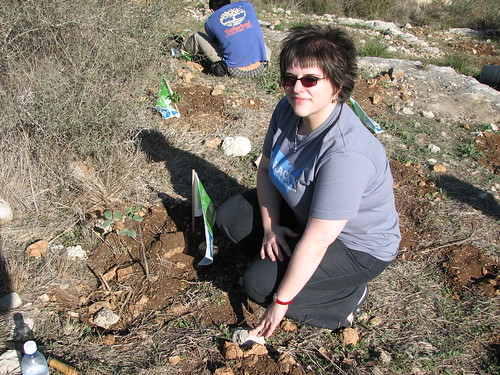
 Today (starting last night and ending today at sundown) is Tu B'Shevat -- the birthday of the trees -- in Judaism! Trees, to be completely honest, are the essence of so much of what being Jewish is about. There are myriad passages in the Bible that talk about trees, being like trees, finding shade under trees, and of course, perhaps the two most important trees, the trees of life and of knowledge. When you visit Israel, one of the most significant things to do is to plant a tree (which was the first thing I did when I got to Israel). In fact, Israel has planted -- in the past 107 years -- 240 MILLION trees. The man-made forests in Israel are a beautiful site, even if they are lined up perfectly so that you know they're man-made.
 So, on this new year of the trees, I give you some wisdom from Rabbi Elazar ben Azaria, a Talmudic sage of the 1st century CE, who said: "Anytime our wisdom exceeds our good deeds, to what are we likened? — to a tree whose branches are numerous but whose roots are few; then the wind comes and uproots it and turns it upside down. ... But when our good deeds exceed our wisdom, to what are we likened? — to a tree whose branches are few but whose roots are numerous; even if all the winds of the world were to come and blow against it, they could not budge it from its place..." And from Mishnah Rosh Hashanah 1:1, we have the call for this, the new year of trees!
There are four new years ... the first of Shevat is the new year for trees according to the ruling of Beit Shammai; Beit Hillel, however, places it on the fifteenth of that month.Also: Two years ago I wrote about this holiday on my blog, check it out for some wisdom from the Lubavitcher Rebbe!
An Orthodox Jew: Part I or, Meeting the Rabbi
From Twitter several days ago:

Yes, it's official. It's true. On Thursday, February 12, 2009, I will be meeting with an Orthodox rabbi to discuss my pursuit of an Orthodox conversion. I know what you're thinking, "Chavi, you're Jewish! You converted almost three years ago!" And the answer to both is "yes." I'm not out to please anyone or to prove to anyone that I'm this Jewish or that Jewish, and it most certainly isn't about securing the comfortable Jewish lives of my future children. Call me nuts or selfish, but it's about me. A lot of people along my path have suggested that Orthodoxy isn't so much what I am, but rather that I'm drawn -- as a zealous convert -- to the traditions, the heritage, the lifestyle, the people. In a way? Yes, that's all very true, but it's so much more than that.
Hashkafically, this is where I'm heading and where I have been heading for the past year and a half or more. I'm not BECOMING a Jew. I already am a Jew. What this is is acknowledging who I am as a Jew.
So Thursday, I will be talking a rabbi. Will I have to go through two years of study -- again? Will I have to start wearing skirts every day? Will I be able to carry on as I am on Shabbos? How can I manage an Orthodox conversion living dozens of miles away from the shul? Will someone start putting me up for Shabbos? Will my current non-shomer negiah relationship be questioned? And most importantly, will I ask all the right questions?
The rabbi I'm meeting with is outstanding and I was sent his way by some friends back in Chicago at the Orthodox shul I went to there. The rabbi sounds eager, and I hope my nerves and apprehensions and my concerns about my logistics don't get the best of me.
Anyone have any tips on things to ask? Any encouragement? Advice?

Yes, it's official. It's true. On Thursday, February 12, 2009, I will be meeting with an Orthodox rabbi to discuss my pursuit of an Orthodox conversion. I know what you're thinking, "Chavi, you're Jewish! You converted almost three years ago!" And the answer to both is "yes." I'm not out to please anyone or to prove to anyone that I'm this Jewish or that Jewish, and it most certainly isn't about securing the comfortable Jewish lives of my future children. Call me nuts or selfish, but it's about me. A lot of people along my path have suggested that Orthodoxy isn't so much what I am, but rather that I'm drawn -- as a zealous convert -- to the traditions, the heritage, the lifestyle, the people. In a way? Yes, that's all very true, but it's so much more than that.
Hashkafically, this is where I'm heading and where I have been heading for the past year and a half or more. I'm not BECOMING a Jew. I already am a Jew. What this is is acknowledging who I am as a Jew.
So Thursday, I will be talking a rabbi. Will I have to go through two years of study -- again? Will I have to start wearing skirts every day? Will I be able to carry on as I am on Shabbos? How can I manage an Orthodox conversion living dozens of miles away from the shul? Will someone start putting me up for Shabbos? Will my current non-shomer negiah relationship be questioned? And most importantly, will I ask all the right questions?
The rabbi I'm meeting with is outstanding and I was sent his way by some friends back in Chicago at the Orthodox shul I went to there. The rabbi sounds eager, and I hope my nerves and apprehensions and my concerns about my logistics don't get the best of me.
Anyone have any tips on things to ask? Any encouragement? Advice?
Books of 5768, at last!
Here's the rundown of books I consumed in 5768. I'm really, really late to doing up this list, but what can you do? I've been quite busy. This is, unfortunately, an incomplete list as the year went on I lost track of many books I'd read. I've put asterisks next to the ones that I highly, highly recommend picking up. Now? I can start up my list for 5769 since we're many months in!
- A Heart of Many Rooms by David Hartman
- Boychiks in the Hood by Robert Eisenberg**
- Choosing to Be Jewish: The Orthodox Road to Conversion by Marc D. Angel**
- Conservative Movement in Judaism by Daniel Elazer and Rela Mintz Geffen
- Davita's Harp by Chaim Potok**
- Embroideries by Marjane Satrapi
- Epileptic (Graphic Novel) by David B.
- Exploring Exodus by Nahum Sarna**
- Faith for Beginners by Aaron Hamburger
- Heat by Bill Buford**
- I Married a Communist by Philip Roth**
- I Was a Child of Holocaust Survivors by Bernice Eisenstein
- I'm Not the New Me by Wendy McClure**
- In the Shadow of No Towers by Art Spiegelman
- Kavalier and Clay by Michael Chabon**
- My Name is Asher Lev by Chaim Potok
- Persopolis I and II by Marjane Sartrapi**
- Rashi's Daughters, Book I: Joheved
- (1/2 of) Rashi's Daughters, Book II: Miriam
- The JPS Commentary on Ecclesiastes by Michael V. Fox
- The Promise by Chaim Potok**
- The Rabbi's Cat by Joann Sfar
- The Search Committee by Marc D. Angel**
- The Song of Songs by Ariel Bloch and Chana Bloch
- Understanding Genesis by Nahum Sarna
Sunday, February 8, 2009
Jew in the City answers all the questions!
I think I have found the Holy Grail of awesomeness in regards to being an Orthodox Jew.
 I have to give a GIGANTIC tip of the hat to Aliza over at Memoir of a Jewminicana for posting these videos, and an even bigger hat tip to the Jew in the City herself, Allison. The videos and blogs over at Jew in the City are devoted to smushing all the crazy rumors about what it means to be an Orthodox Jew. The author was raised Conservative, and now is proudly an Orthodox Jewish woman living in the city. There is a blog, videos, a Q&A section, and even the option of leaving your number so that maybe, just maybe, Allison will field one of your questions. I really think this is an amazing thing she's doing, and I hope the videos persist. Here are a few of them on questions that we ALL field regularly -- what makes things kosher and, really, you have sex through a hole in the sheet, right?

Like the eruv on Shabbos, Haveil Havalim is up!
Esser Agaroth is hosting this week's Haveil Havalim -- the Jewish blog carnival -- which is in its 203rd incarnation. I'll be hosting HH in all its splendor in about a month, when I have some Spring Break time at the beginning of March.
So go, read up, and me? I'm going to take a nap.
So go, read up, and me? I'm going to take a nap.
Friday, February 6, 2009
Guilt = Money for Charity
Absolutely famished, I made dinner, scarfed it down, and about 15 minutes later realized what an absolutely STUPID thing I had done. I made a huge party foul in the likes of catastrophe. I'm so angry at myself. So I went first thing to AskMoses.com to get some wisdom -- what does someone who severely busted the laws of kashrut do to amend? I mean, this isn't Catholicism folks, you don't confess. You just sit around with loads of guilt, waiting for the incident to escape your mind. And then something else happens and it's a vicious cycle! So what did the nice woman at AskMoses.com tell me to do? She suggested I pay more attention to what I'm eating, which is a given, and that I donate money to a food-oriented charity.
So Mazon, please take my guilt money and use it for a good thing.

So Mazon, please take my guilt money and use it for a good thing.
Thursday, February 5, 2009
Is it kosher?

I've taken to drinking Soy Milk in my coffee drinks, mostly because then I don't have to worry about whether I'm drinking it four hours post-meat meal or otherwise. This was a relief for Tuvia, who loves having coffee at work. Right? Wrong. I've always been conscious of the fact that Silk Soymilk, which you can find at Starbucks and most other coffee shops, is OU-D, meaning it's Kosher by the Orthodox Union, but Dairy. A friend of mine wouldn't hesitate to order a coffee with soymilk at Starbucks after a meat meal and she was definitely kosher. So I never thought much of it. Obviously, the Soy Milk is produced on dairy equipment or in a facility where dairy is processed, and that's all there is to it, but I know plenty of vegans who live on Silk Soy Milk, so it's got to be legit. I mean, I love the Chocolate Silk!
So after thinking more about it, and needing some type of proof to back up my assumptions about why I feel okay drinking Soy Milk after a meat meal (and, to be honest, I rarely eat meat during the day, and mostly only on Shabbos or when I'm out with Tuvia), and so I found the Kosher Blog's write-up on this issue from July 2008.
The actual container of Silk Soy Milk says "It's Free! Silk Soymilk is free of lactose, dairy, cholesterol, gluten, eggs, peanuts, casein, MSG and worries." But with the OU-D label, some explaining is needed. According to the Kosher Blog:
In case you didn’t get it:
The D designates that the dairy-free product was heated on equipment also used for dairy and may not be eaten together with a meat product. It may be eaten immediately after a meat product, but not together [emphasis mine].
So there you have it. You can eat it immediately after a meat product, but not together.
I e-mailed the OU just to be 200% sure, and they confirmed that all Silk products are parve but made on dairy equipment. The e-mailer added the following:
You will not find the DE designation on a product certified by the OU. The OU designates dairy-free products made on dairy equipment with the ‘OU-D’ symbol and not ‘DE’ (Dairy Equipment). This due to the fact that the OU has seen that in industrial applications, very rarely is a proper cleanup performed after a dairy run before the Pareve run. As a result there is a problem of dairy residue entering the so-called Pareve product.
This seems reasonable to me, but I would not worry about it in the case of Silk products, since the company is adamant about its products being safe for those with dairy allergies, which requires an extremely high level of cleanliness. And of course, the OU says that you can have them after meat. So you can have them after meat.Thus, I feel vindicated. If anyone has another take on the topic, please let me know. I know there are those who are HARDCORE with the kosher and wouldn't think of even looking into this and would rather err on the side of not even going for it, but, well, that's not my style. If it's good enough for the OU, it's good enough for me.
(PS: This is post 701! Wow!)
Subscribe to:
Posts (Atom)