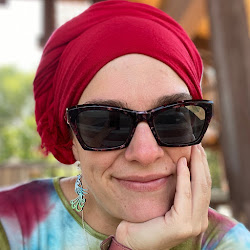
Oh baby, it's cold outside! And inside. In Austin, Texas, no less.
I've been here since early yesterday afternoon, and I've spent a measly couple of hours at SXSW Interactive so far. Why? Shabbat, of course! Luckily, tomorrow I fully intend on being the very first person in line at registration -- coffee in tow!
There are three solid days of the festival left, and I plan on doing as much schmoozing, drinking, partying, connecting, and schwag-grabbing as possible. If you're here at SXSW Interactive, let me know, just tweet me @TheChaviva -- if you're lucky I'll buy you a coffee.
Also: Mad thanks to @ROICommunity for putting all of us up in a beautiful house in the hills of Austin and for helping those of us who are here be here.
Sunday, March 11, 2012
Saturday, March 10, 2012
Change.
Clearly, everything from the traditional www.kvetchingeditor.com is gone!
But, I still need a website to look like a capable Social Media maven. So this is a work-in-progress.
Stay tuned for awesomeness.
But, I still need a website to look like a capable Social Media maven. So this is a work-in-progress.
Stay tuned for awesomeness.

Wednesday, March 7, 2012
So Long, Farewell.
At the request of Orthodox converts and Orthodox Jews everywhere, I'm putting the kabosh on my blog. Clearly, I'm hurting everyone everywhere, without intending to. I'm sorry to all who I have harmed in the production of this blog, and after nearly six years of blogging, this site will serve as an archive.
Of course, if I end up back on the "derech" that Orthodox Jews expect, maybe I'll start blogging agin, but who knows.
This blog has always served as my therapy, as a way to express my thoughts, emotions, and journey to Judaism. I never thought that I would become a "beacon" for Orthodox converts, nor did I think that I would come to loathe denominationalism so much for driving a wedge between who I am and how people view me.
If you have questions about conversion, you might want to direct them to someone who is "on the derech" since I'm a pariah at this point. If you still feel compelled to email me, you've been warned.
To everyone who has supported me -- thank you, eternally.
Of course, if I end up back on the "derech" that Orthodox Jews expect, maybe I'll start blogging agin, but who knows.
This blog has always served as my therapy, as a way to express my thoughts, emotions, and journey to Judaism. I never thought that I would become a "beacon" for Orthodox converts, nor did I think that I would come to loathe denominationalism so much for driving a wedge between who I am and how people view me.
If you have questions about conversion, you might want to direct them to someone who is "on the derech" since I'm a pariah at this point. If you still feel compelled to email me, you've been warned.
To everyone who has supported me -- thank you, eternally.
Monday, March 5, 2012
Ask Chaviva Anything!: Did Divorce Hurt?

I know this questions thing is a bit old -- but I hope you can still answer. I know your divorce was amicable, but does it hurt you at all that your ex-husband has moved on so quickly? I'm thinking such a short time for a person to move on is a bit strange.My opinion? It is strange. My ex met his now wife about two weeks after our get (religious divorce) was finalized, and they were engaged a few months later. They recently got married, and I wish them all the mazal and happiness in the world. But yes, I find it quite bizarre. To get married five months after a religious divorce and two weeks after a civil divorce seems, well, fast. Really fast.
Ultimately, I think it comes down to how we choose to cope with major events in our lives. Having lived in Teaneck in the community that we lived in, I know that there is a pressure to fit the mold of being married, considering kids, toying with buying a house and so on. If I had stayed in the area, I probably would have done the same thing.
But I coped by getting out, starting fresh, and figuring out what kind of life I wanted for myself, outside the mold of the expected. A lot of people think I've gone off the deep end by not officially affiliating as "Orthodox" per se (although, let's be honest, it's the closest thing denominationally to what I am, but my dating a non-Jew more or less shoves me out of that camp even though we all know a million people on the Upper West Side have done it, are doing it, or are not concerned with shomer negiah). Would they think the same if I was a divorced born-Jew? Who knows.
Does it hurt? Of course it hurts. When we divorced, I lost the only Jewish family I had ever known -- and let me tell you, that family was the most amazing family a girl could ask for. I lost two bubbes, in-laws who had a pride in me that shone so brightly, tons of cousins (who, thankfully, still talk to me), and so much more. That was the big hurt, losing family. I was so entrenched in their lives, their histories, their genealogies. Hearing my former father-in-law tell me he was proud of me was something that I cannot even put into words. Losing that destroyed me. And when I think about the divorce now, it's the thing that hurts the most.
Wait, I'm lying. Well, half-lying. The thing that ultimately hurt the most was feeling replaceable. My ex found his new wife within a few weeks of our get, within a few weeks of me asking for the darn thing. After all, I asked for the divorce and a week later we were at the beth din making it happen. Knowing that the empty space of "wife" could be filled so quickly is something that continues to damage me. Rejection is hard, and between September and November of 2011, I was rejected by several people who I had given so much to. That rejection tore a piece of the fabric of me, and it has yet to be restitched.
More of an answer than you bargained for? It's been hard to not write about the divorce. I've gone through all the stages of grief and then back again. Knowing what I suffered while in the relationship -- mentally and emotionally -- and then knowing that everything started over so quickly for my ex-husband made me wonder if I was living in some imaginary dream world for the 16 months we were married. It's a fog to me now, and I'm lifting the fog slowly but surely. Thankfully, I have amazing friends here in Denver like @melschol and back East like @heysuburban and, of course, Taylor, to remind me that I'm not replaceable.
The upside is that I've never felt like a failure in marriage. I just made a few stupid mistakes of trusting, revealing, and believing that I won't make again unless it's with the right person at the right time.
Ask Chaviva Anything!: Conversion, Divorce, and Observance
Some of these will be heavy. Are you ready?
I'm curious to hear your self-observations on your religious practice (1) Before you were married, (2) while engaged, (3) while married, and (4) while divorced. Did you find yourself more strict in certain areas at different phases, less strict?This is a most excellent question. How to answer? I can say without flinching that my religious practice before I was married was much more "full" if that makes sense. My observance was about me, and me alone. When I got engaged, I was able to begin looking at other observances that I was to be taking on come marriage time. While married, I began to feel a little lost. Living in Teaneck, NJ, my religious practice became more rote because it was easy to be Jewish. You didn't have to think about practice or observance; everyone just did the same things, ate at the same places, went to the same synagogue. I think that while I was married I regressed a lot in the sincerity of my observance. Now that I'm divorced, I'm in a place of reexamining my religious practice. As a result, you might say I'm "less strict" than I was while married or even engaged, but I think that is probably a natural progression for many when divorce comes. Either that, or you throw yourself into strict observance to fill the void. But right now, I'm in a comfortable place.
Could you walk us through the thought process you had when choosing to leave the NY/NJ area as a new single with hopes of remarrying?Well, for starters, I didn't have hopes of remarrying, and to be honest I still don't. Leaving NY/NJ was a simple choice. I needed to be someplace where I could clear my head and start fresh on a life that was all my own. This wasn't the first time I've done this. I picked up and moved to Chicago once on a whim, and did sort of the same thing when I quit Chicago and headed for Connecticut. I'm a move-on, start-over kind of person. It's just how I function.
That first month after the religious divorce -- the get -- I was in a head-spinning place of "Meet someone super religious right now and get married to them right now." Luckily, I got out of that headspace. My ex-husband went that route, whereas I went a different route. I reevaluated my family background, my religious headspace, my wants and needs, and at the current juncture, I have no desire to get married or have kids. There are a lot of reasons for this that I haven't discussed on the blog (shocking, I know), but it's a decision with which I've definitely made peace.
What systems of support do you wish existed for the potential convert, convert engaged with a beis din, and the convert post facto (a Jew)?The essential system of support should simply be whatever community the convert -- at any stage -- lives in. There shouldn't be a need for some kind of special community or foundation to support the convert, but that's an unfortunate reality and it is why there are organizations devoted to assisting converts in Israel. So I run my Conversion Conversation Group on Facebook for individuals at all stages of the process, and I've found that just having a safe space away from the eyes of rabbis and the prying community has helped so many feel comfortable.
If you could pick one time period of Jewish history in which you could witness (i.e., live through it) what historical period/events would it be?Without a doubt the Middle Ages. It was such a tumultuous and inspiring time to be a Jew, I think. I would have loved to meet Ovadiah ha'Ger, Maimonides, and the like. There was so much movement between Europe and North Africa, and I think that experiencing Egypt during this time would be quite beautiful. On the same note, I would have loved to float around Europe at this time!
What mitzvos do you feel most connected to? The least?Without a doubt, I feel deeply connected to prayer -- simple things like the Shema and Modah Ani. They keep me on a cycle of waking and sleeping, living and dying. I also feel deeply committed to kashrut, the true roots of kashrut and what it means to understand food and consumption. On that note, I'm also connected very much to tzniut, in all of its forms, but especially in speech. As for those I'm least connected to, that's a good question. I suppose taharat ha'mishpacha (family purity), largely because the span of my marriage that I observed it, it was a dismal experience. Mikvah in that realm, too, held little comfort for me. That being said, when I observed mikvah for conversion, it was an incredibly powerful experience.
Also: I think that living in -- or at least regularly experiencing -- Israel is a huge mitzvah. That's probably the one I feel most connected to overall!
How connected to your "old life" do you feel? Meaning how has your mentality changed since becoming more observant/converting in terms of world view, politics, priorities?The truth is, I don't think that I've changed much, outside of feeling more worldly and interested in how the world functions and how it understands religion, peoplehood, race, ethnicity, and identity. Converting to Judaism and becoming more observant has taught me that our (the Jews) greatest enemy is ourselves. I find it constantly troubling how Jews are willing to join forces to fight outsiders but insist on continuing to judge and break down one another. (A great example: Reform Jews recently spoke out in support of Beren Academy when they were told that their basketball game couldn't be rescheduled. How is that relationship the rest of the year?)
I think, if anything, that I've simply come to be who I always was: curious and searching, believing with a sound mind and full heart that there is one G-d and that our actions in this life are what matter the most. Those are values and a mentality that I have held since I was a child, and those are the things that led my neshama to really thrust itself into the spotlight and led me to realize my Jewish self.
Beans, Beans, Esther's Favorite Treat!

I have little moments like this every now and again, but it's happened again and I can't help but share it with you all. It makes me feel at ease to know that HaShem will provide.
Last Saturday night, Taylor and I were at Target shopping for my Mishloach Manot goodies. I originally had had a plan about doing something according to Caffeine Dreams, but it just wasn't flying. Then, I thought what about something about being a kid again, but that also didn't fly. And then, I got this urge to do something with beans. I didn't know why, but I suddenly had an array of bean-themed items at the ready in my cart. I kept trying to come up with some creative wordplay -- "It's BEAN a rough time for the Jews!" but it just wasn't floating. I've spent the past week trying to figure out how to make it work, without luck (and that goes the same for my gluten-free hamantaschen adventures).
Then, earlier today, I was floating around MyJewishLearning.com taking a Purim Quiz when I saw something that caught my eye: Chickpeas for Purim.
What!?
Then I read on and learned the following:
According to tradition, while Queen Esther lived in the court of King Achashverosh, she followed a vegetarian diet consisting largely of beans and peas so that she would not break the laws of kashrut (dietary laws). For this reason it is customary to eat beans and peas on Purim.
No. Way. Seriously? Beans on Purim? It's bashert!
It's little happy moments like this that remind me how close my relationship with my Judaism is. How sometimes everything is threaded together without us even knowing it.
And now I bet you wonder what's going to be in my Mishloach Manot, right? Well, as soon as I hand them out, believe me, I'll let you know. Until then ...
Learn to Eat Like Esther on Purim!
EDIT: Sources for this minhag are ... Targum Esther 2:7and Midrash Panim Aherim 63 and 64 (the Talmud, Megilla 13a, also mentions that Esther only ate permitted food, and one could deduce that that would necessitate a vegetarian diet).
EDIT: Sources for this minhag are ... Targum Esther 2:7and Midrash Panim Aherim 63 and 64 (the Talmud, Megilla 13a, also mentions that Esther only ate permitted food, and one could deduce that that would necessitate a vegetarian diet).
Sunday, March 4, 2012
Pledging Jewish Allegiance: Part II
You can read the first part of this multi-part look at Pledges of Jewish Allegiance and responsa about conversion in the Nineteenth and Twentieth centuries here.
What is the purpose of [writing in the Torah], "And Lotan's sister was Timna"? -- Timna was a royal princess, as it is written, aluf Lotan, aluf Timna; and by aluf, an uncrowned ruler is meant. Desiring to become a proselyte, Timna went to Abraham, Isaac, and Jacob, but they did not accept her. So she went and became a concubine to Eliphaz, the son of Esau, saying, "I had rather be a servant to this people than a mistress of another nation." From her, Amalek was descended who afflicted Israel. Why so? -- Because they should not have repulsed her. (29)
The passage doesn't state why Timna should have been accepted, but it does suggest that "when people are turned away, the implications for Jewish security in the future can be very problematic." Hell hath no fury like a potential convert scorned?
Maimonides, writing in the late Twelfth Century, discusses the idea mentioned in the last blog post of intention at length when detailing how to handle a potential convert.
The appropriate way to perform the commandment [of conversion] is that when the convert comes to convert, we investigate him lest [he be converting] for money that he will receive, or for some position of authority that will come his way, or whether it is because of fear that he wishes to enter the religion. If he is a man, we investigate whether he has cast his eye on a Jewish woman; and if she is a woman, we investigate whether she has cast her eye on a Jewish man. If no inappropriate motivation is discovered, we inform him of the magnitude of the weight of the yoke of Torah and of the tremendous efforts required from Gentiles to perform [its commandments]. If they accept and did not change their minds and we see that they have returned out of love, we accept them. (30-31)
The new and interesting thing about this is that it suggests that the court be compelled to investigate, not that the court simply turn someone away because their motives might be suspect. You will notice, oddly enough, that in this bit from the Mishneh Torah Maimonides says absolutely nothing about acceptance of the mitzvoth (commandments). After all, the text merely says that the potential convert is "informed" of the weight of the yoke of Torah -- not that he or she must accept it or be fully educated on it prior to conversion. In later responsim, rabbis will use these ambiguities to support their own points.
And then, of course, there's this, which comes later from Maimonides, is a big deal, and I think that this should inform how we view conversion today.
A convert whom they did not investigate or to whom they did not make known the commandments and the punishments [for not fulfilling them] but who was circumcised and immersed in front of three judges is a convert. Even if it subsequently becomes known that he converted for some ulterior motive, once he has been circumcised and immersed, he has been removed from the status of Gentile, and he remains suspect until his righteousness can be verified. Even if he returns to Gentile worship, he remains in the category of a Jewish apostate whose marriage is a valid marriage. (32)
BAM! This very passage from the Mishneh Torah, says volumes about the convert -- volumes that many modern rabbis seem to ignore when they think that they can revoke a conversion. Even in the Beit Yosef, Rabbi Karo follows Maimonides' claim that all conversions are valid, regardless of whether the courts have investigated and that it is "obvious" that failure to accept the commandments does not render the conversion invalid after the fact (36). It also must be mentioned that both Maimonides and Karo agreed that every case with conversion is different, unique, and specific to the time and place and that every court must handle the case accordingly. In essence, there is no simple way to hold every potential convert to the same process and same procedures.
In just about everything that Maimonides says regarding the convert, it is clear that he values and respects the position of he or she who joins the fold. In a query from Ovadiah ha'Ger as to whether he should amend the liturgy and avoid phrases like "God and God of our fathers," given his status as a convert, Maimonides had this to say:
You should recite everything as it is, and do not change anything. Rather, you should pray as every Jewish citizen does, whether alone or in public. The critical point is that it was Abraham our Father who taught the entire nation, who gave them the wisdom and who made known to them the truth and unity of God. He battled against idolatry ... and brought many under the wings of the Divine Presence. ... Thus, anyone who converts until the end of time ... is a disciple of Abraham our Father and a member of his household. ... Thus, you should say "our God and God of our ancestors" ... -- there is no difference here between you and us.
It's statements like this, from one of the greatest sages of all time, that makes me wonder why we've fallen so far.
I'll conclude with this portion of the series by saying that many rabbis in later times who sought to make it "easier" to convert followed the position of the Beit Yosef in the emphasis on the discretion of the court while also debating what exactly "for the sake of heaven" means in Maimonides' initial dictum about the conversion process. In future posts, you'll see how confusing and convoluted the debate becomes based on the writings of Tractate Geirim and the works of Maimonides.
Still: Think back to what Maimonides says about once a convert, always a Jew. Why can't we live by this simple dictum?
Pledging Jewish Allegiance: Part I

The authors of this volume are David Ellison and Daniel Gordis, the former is the president of Hebrew Union College (a Reform institution) and the latter is a popular speaker on Israel and is the president of the Shalem Foundation. The book was written over a period of a decade, according to the acknowledgements, and I imagine the push to get it printed now, at this very moment, was because of the increased intensity in the U.S. and Israel over the "Who is a Jew?" question regarding conversion.
The first thing that caught my eye in this book was the fact that the entire first chapter discusses the "geir" as meaning convert in the bible. I don't know how many times I have to say it, but there is absolutely zero proof that any use of the term in the bible meant anything other than stranger.
Jewish tradition permits the convert to join the Jewish people but often makes it difficult for him to do so. Even the Bible's word for "convert," geir, reflects this conflict, for geir means not only "convert" but "stranger" as well. The Bible refers to the convert as a geir even after he has joined the Jewish people. (14)I can't express how distraught I was after reading this. The truth is that I really just wanted to put the book down at this point, because from an academic (and personal) standpoint, this is ignorant academics. In most of the instances in the Bible where this term is used, the understanding is that the individual being called a geir has simply tagged along with the Jewish people, he or she is a stranger among the Israelites. There is no formal layout for conversion at this point in the Israelite narrative, and the closest we truly get to someone in the bible converting is in the story of Ruth, who says that the Israelites will be her people and that their G-d will be her G-d. Other than that, the closest perhaps is Yitro (Moshe's father in law), but even there the rabbis and scholars struggle with whether he "converted" to become an Israelite as he joined the people and then subsequently left -- problematic when community is so important to the conversion narrative.
That being said, the meat of the book is interesting and informative about how we got from the Nineteenth Century to now and what exactly shaped modern-day rulings and concerns about motivation, acceptance of the mitzvoth (commandments) and what that means, and so on. Before I cut myself off (because I don't want to write five-million word long blog posts) I do want to share one thing that will set the stage for us that comes from Tractate Geirim, a minor tractate not formally part of the Mishnah (Oral Torah) and typically dated somewhat later.
Anyone who converts [in order to marry] a woman, for love or out of fear, is not a convert. Thus, Rabbi Judah and Rabbi Nehemiah used to say that all those who converted in the days of Mordecai and Esther are not [valid] converts, as it is written, "and many of the populace were converting to Judaism, for the fear of the Jews had fallen upon them." And anyone who does not convert lesheim shamayim [for the sake of heaven], is not a [legitimate] convert." (24)The interesting thing about this particular passage is that it informs what the rabbis discuss in the Eighteenth and Nineteenth centuries -- but not in a way that you might expect. Ultimately, this very specific dictum is brought into question amid a rise in intermarriage and the Enlightenment period.
So I'll leave this one at this for now. Stay tuned for a multi-series look at some of the responsim and exactly what they mean for us today.
Particularly! Look out for what Maimonides has to say on the whole thing. It might surprise and delight you!
Are You Friends with Esther?
[Come tomorrow, I'll post images of my OWN hamantaschen!]
It’s the month of Adar, and that means it’s time for Purim, one of the most festive holidays in the Jewish calendar. Everyone is a’twitter with talk of mishloach manot (gift baskets), hamantaschen, costumes, festive meals, Megillat Esther readings, Purim shpiels, carnivals, and more. Commemorating a time when a young Jewish woman, Esther, rose to power to become Queen of Persia under the tutelage of her guardian Mordechai, the Purim story tells of Esther risking her life to save the Jews from the evil Haman. The story concludes with the Jews turning the tables on their enemies, who are punished in place of their intended victims. This miracle is the major theme of Purim, and it’s clear that — although not mentioned in the entirety of the Book of Esther — God is behind the scenes “pulling the strings.” The story of Purim gives us hope that no matter the circumstances, redemption is right around the corner. It took just one person — Esther — putting herself in harms way by speaking out against an imminent evil to save an entire people.
So what if the Purim story were unraveling in today’s times? Would Esther be blogging her tough decisions? Would Mordechai be writing on Esther’s Facebook wall “Risk your life! Save the Jews!”? And what about Haman, would he unfriend Esther after his plot was ruined?
The reality today is that you can find Pinterest boards full of images of delicious varieties of hamantaschen, costume ideas, and Purim decorations. You can hop over to YouTube and find plenty of Purim-themed videos or visit Facebook to “like” Queen Esther. You can even listen or watch the Megillah read online! But Esther probably would have used social media for more than just finding the fun and entertaining pieces of Purim.
In our modern, digitally social world, local and international events of persecution make it to the internet in no time. The internet is a great place to plan your Purim party or to connect with others about meal ideas, but it’s also a powerful means of social action. If you haven’t taken the time to check out how we’re using social media, we urge you to hop online and test the waters of Twitter or Facebook to see how you can impact change in a new, virtual environment. Whether it’s donating to an impactful organization or speaking out against injustices, you cannot imagine the power your virtual voice can have.
Be a modern Esther, and help the essence of Purim go viral! Best wishes for a festive Purim!
To be honest, I was surprised that my past writings on Purim are pretty nil. Have a favorite d'var or blog post written about Purim? Let me know!
Also, if you need a really good laugh, read this.
Friday, March 2, 2012
Wednesday, February 29, 2012
Keep Calm and Be Jewish
Someone had to do it, and that someone was me, evidently. I think I used the wrong font after the Keep Calm and Cholent On ... I should fix that!


Tuesday, February 28, 2012
Greek Esther: It's What's for Purim!
I'm recycling this from 2010, but, well, I thought y'all should know about Greek Esther. Read on!
For those of you looking for a little something more in your Purim, I highly recommend looking up or checking out a copy of Greek Esther. The version we read and know now is Hebrew Esther. There are three main versions of Esther that float around -- Hebrew, Greek, and the Alpha text. The latter is a Greek text that pretty much resembles the Hebrew version we have today (a translation). However, "Greek Esther" is a version of the Esther story that is about 170 lines longer, includes tons and tons of HaShem, and has many inclusions in it that make the modern reader question why the rabbis chose to canonize Hebrew Esther, not Greek Esther. After all, Hebrew Esther doesn't mention HaShem, not once. In Greek Esther, Mordechai and Esther pray to HaShem, Mordechai has a vision about HaShem's plan, and more.
The simplest answer, of course, is that the longer version was written in Greek and Greek = bad. Another theory is that there originally was a longer Hebrew Esther that the Greek Esther was based on, but because it was lost by the time the rabbis got to it, they still believed that Greek = bad. My question is why they didn't translate the longer version into Hebrew and go with it (heck, burn the Greek copy!). Of course, the rabbis would probably say that the whole point of Esther is that HaShem, while implicit, must be hidden for the story to be truly impactful as it takes place in the Diaspora. The funny thing is that the Rabbis, in the Midrash, essentially DO what Greek Esther does in that it elaborates and sort of embellishes the Hebrew Esther and the result is that if you read Hebrew Esther with the Midrash you sort of get the same feel as Greek Esther.
Anyhow, I could talk about this for hours, but what I'm saying is this: Go read Greek Esther. It'll BLOW your mind. Chag Purim Sameach!! Chaviva out!
For those of you looking for a little something more in your Purim, I highly recommend looking up or checking out a copy of Greek Esther. The version we read and know now is Hebrew Esther. There are three main versions of Esther that float around -- Hebrew, Greek, and the Alpha text. The latter is a Greek text that pretty much resembles the Hebrew version we have today (a translation). However, "Greek Esther" is a version of the Esther story that is about 170 lines longer, includes tons and tons of HaShem, and has many inclusions in it that make the modern reader question why the rabbis chose to canonize Hebrew Esther, not Greek Esther. After all, Hebrew Esther doesn't mention HaShem, not once. In Greek Esther, Mordechai and Esther pray to HaShem, Mordechai has a vision about HaShem's plan, and more.
The simplest answer, of course, is that the longer version was written in Greek and Greek = bad. Another theory is that there originally was a longer Hebrew Esther that the Greek Esther was based on, but because it was lost by the time the rabbis got to it, they still believed that Greek = bad. My question is why they didn't translate the longer version into Hebrew and go with it (heck, burn the Greek copy!). Of course, the rabbis would probably say that the whole point of Esther is that HaShem, while implicit, must be hidden for the story to be truly impactful as it takes place in the Diaspora. The funny thing is that the Rabbis, in the Midrash, essentially DO what Greek Esther does in that it elaborates and sort of embellishes the Hebrew Esther and the result is that if you read Hebrew Esther with the Midrash you sort of get the same feel as Greek Esther.
Anyhow, I could talk about this for hours, but what I'm saying is this: Go read Greek Esther. It'll BLOW your mind. Chag Purim Sameach!! Chaviva out!
Friday, February 24, 2012
Parshat Terumah: Giving & Taking

It's a particular word spin, and I hope it makes you pause. The Big Man speaks, saying we should take from ourselves -- but only if we're inspired! The verb that's used does not mean give, it means quite literally to take, which also is peculiar because how does one take of himself or from himself? How does one provide a contribution on command and guarantee that it's genuinely inspired?
Very little of giving today happens on demand. HaShem doesn't call us on Super Sunday and say we have to give to our local federations or that the local Jewish retirement facility needs funds so we must give. And even if that did happen, would we? What compels us to give? Is it the action of taking of ourselves rather than giving of ourselves? It becomes a two-way street when you take something from your own life, from your own lot, and provide it for others. When you give, it's less so.
I want to start using more folktales on the blog (and really, who doesn't), so let's start with this one, a Yiddish one, that offers perspective on the difference between "giving" and "taking."
"Yankel the Cheapskate" would not give money to anyone, for any reason. It didn't matter how important the cause. No one could crack him. He just wouldn't contribute. One day, Yankel was crossing the river in a small boat. Suddenly, a huge storm breaks out, and his boat capsizes. Luckily, another boat approached. The sailor calls out to him: "Give me your hand. Give me your hand."
Yankel can barely hear him over the strong winds and the roaring waves. He hears only one word, over and over: "Give, Give..."
And good old Yankel can't help himself. He yells back: "No. I don't give. I don't give."
Again: "Yankel, give me your hand! Give me your hand." And again Yankel screams: "Never. I don't give."
Finally, in desperation, the rescuer yells: "Yankel, take my hand." And Yankel says: "Oh, take? Sure."
I think that this week's parshah offers a spin on what we considering taking. To take something from someone else benefits the self, so perhaps HaShem knew that asking the Israelites to take of themselves would give them a chance to feel a part of the building of the mishkan. No matter how poor or rich, old or young, everyone provided for the construction. Everyone took of themselves to put into the construction of a dwelling place for the shechinah (the divine presence of HaShem).
An old adage says that "A fool gives, a wise person takes." Be the wise person and whenever you offer a contribution or gift, make sure that you're taking of yourself and not just giving. Okay? Okay.
That's your public service announcement for Shabbat. If you want more on the awesome goodness that is tzedakah, I suggest you check out Maimonides Eight Levels of Charity, which is fascinating.
The Second-Time Single Trend
I didn't know there was a name or a category for what I am, but someone sent over a Tablet article today that gives me one of those fancy ways to describe myself: "Second-Time Single."
Now, I know that I'm not technically single because I'm currently in a very happy relationship with Taylor, but for the greater Jewish and Orthodox world, what I'm doing isn't dating, it isn't serious, it isn't real in a sense. "She'll come around!" they say. "She's divorced and acting out!" they say. "Let us know when you're ready to date a Jew again!" they say.
At any rate, the article is quite interesting. I don't know that if any of these kinds of Second-Time Singles events would have "saved" me from my current situation as I don't think I was ready to date when I met Taylor. Sometimes, life just happens. I am glad, I will say, that the Jewish community is attempting to do something for the demographic of 20s, 30s, and 40s who are divorced or widowed -- it's a lonely, confusing road.
Also, I have to say -- not unpredictably I might add -- that (in the article) the shadchanim (matchmakers) that set up Second-Time Singles often set them up with other Second-Time Singles, and that grates my cheese. I think it's one thing that will never fade in the Orthodox community: Once you get divorced, you're damaged goods so you get married off to another divorced individual or an older individual. It's the same with converts, as matchmakers often try to pair them with other converts. I understand the sentiment -- oh, we've been through something similar, right? -- but no two people go through an experience and come out on the other side the same, so why try making that connection?
Maybe I'm just grumpy today. Anyway, let me know what you think about the article.
Now, I know that I'm not technically single because I'm currently in a very happy relationship with Taylor, but for the greater Jewish and Orthodox world, what I'm doing isn't dating, it isn't serious, it isn't real in a sense. "She'll come around!" they say. "She's divorced and acting out!" they say. "Let us know when you're ready to date a Jew again!" they say.
At any rate, the article is quite interesting. I don't know that if any of these kinds of Second-Time Singles events would have "saved" me from my current situation as I don't think I was ready to date when I met Taylor. Sometimes, life just happens. I am glad, I will say, that the Jewish community is attempting to do something for the demographic of 20s, 30s, and 40s who are divorced or widowed -- it's a lonely, confusing road.
Statistics about the number of Orthodox second-time singles are hard to come by. Dr. David Pelcovitz, professor of psychology and education at Yeshiva University, said that while there is no “reliable, solid, empirical source” for such information, “there’s a sense that there are more divorces. It’s incredibly unscientific but, for example, when I give talks at rabbinical conferences, I ask, ‘How many of you have experienced a divorce in your community in the past few years?’ You get more people raising their hands. When I ask the people who are doing work in Jewish divorce courts, they tell me that they seem to be busier.”I think a lot of people fall into bad relationships after divorces just to continue fitting the mold of their community. It's as if there's a conveyor belt of spouses ready to go just so everyone can fit that perfect get married, move to a newly marrieds community, have a baby, buy a house, move to a family community kind of plan. I worry about a lot of people I know who get back into it too quickly.
Also, I have to say -- not unpredictably I might add -- that (in the article) the shadchanim (matchmakers) that set up Second-Time Singles often set them up with other Second-Time Singles, and that grates my cheese. I think it's one thing that will never fade in the Orthodox community: Once you get divorced, you're damaged goods so you get married off to another divorced individual or an older individual. It's the same with converts, as matchmakers often try to pair them with other converts. I understand the sentiment -- oh, we've been through something similar, right? -- but no two people go through an experience and come out on the other side the same, so why try making that connection?
Maybe I'm just grumpy today. Anyway, let me know what you think about the article.
Wednesday, February 22, 2012
A Quick Favor
Hello friends. It's me, your overly busy and completely unpredictable and lacking in sleep blog host, Chaviva! I'm here, briefly, ever so briefly, because I'm working to the point of brain-explosion and not eating and ... well, you get it.
Anyway, I have a huge favor to ask.
I'm trying to help collect money to get our Hebrew High Denver and Boulder Hebrew High students to New Orleans for a service-learning trip.
Anyway, I have a huge favor to ask.
I'm trying to help collect money to get our Hebrew High Denver and Boulder Hebrew High students to New Orleans for a service-learning trip.
Got $18 to spare? Please oh please help them out! These are our future leaders doing good in NoLA!
Just go to https://interland3.donorperfect.net/weblink/weblink.aspx?name=caje&id=1 and make sure to mark it down for Hebrew High and for the Service Learning & Leadership Trip.
I'll love you forever. And maybe I'll bake you something, too.
Thursday, February 16, 2012
Observance, Ethics, and Being a Good Jew
I want very much to thank Stella for passing this along to me. I'm surprised I missed this back when it printed in 2010, but, well, life was in a funny place at the time.
The article -- Joining the Covenant -- was posted on Jewish Ideas Daily more than two years ago, and it was written by Rabbi Irving Greenberg (aka Rabbi Yitz Greenberg), a modern-Orthodox Jew, and details his thoughts about synthesizing "traditional requirements of the law with a principled openness to converts who will not become fully Orthodox."
The article is beautifully written, and I want to highlight a few thing that he says that gives me peace in my perpetual state of flux as an underconstructionist Jew.
The article -- Joining the Covenant -- was posted on Jewish Ideas Daily more than two years ago, and it was written by Rabbi Irving Greenberg (aka Rabbi Yitz Greenberg), a modern-Orthodox Jew, and details his thoughts about synthesizing "traditional requirements of the law with a principled openness to converts who will not become fully Orthodox."
The article is beautifully written, and I want to highlight a few thing that he says that gives me peace in my perpetual state of flux as an underconstructionist Jew.
Furthermore: I believe with perfect faith that God loves and honors good, serious Jews-whether or not they keep all the mitzvot. I believe that the merit of the mitzvot they do keep, including in the form of good deeds and self-sacrifice, outweighs all the punishments that can be incurred by non-observance, and that God will treat them accordingly.
Also:
As a concluding note I add this: when it comes to defining a good Jew, stressing the "particularist" ritual mitzvot over against the "universalist" mitzvot of ethical behavior is itself a gross distortion.
I think Rabbi Greenberg has hit the nail on the head. So often, we forget what it means to be a Jew. We also forget that our actions are our own in the end and only HaShem has a right to say, think, or act on our individual neshamot.
It's an old article, but it's worth a read and a consideration, if not more -- action.
Tuesday, February 14, 2012
It Seems I'm Influential in Certain Circles

That said, I've got some book reviews and goodies and questions in the queue, so hold your horses.
I did want to mention that the National Jewish Outreach Project announced their first list of Top 10 Jewish Influencers.
Finalists were selected by an expert panel of judges and evaluated based on creative and strategic use of social media to positively impact the Jewish community. Winners will be listed on the NJOP website, featured on @JewishTweets and invited to participate in 2012 NJOP social media programming.
“We launched @JewishTweets in March 2008 and from the outset, embraced it for the way it allows us to connect with people everywhere. It has allowed us not only to be heard, but to listen and be inspired by others every day,” said Ephraim Z. Buchwald, founder and director of the National Jewish Outreach Program. “In particular, we wanted to take time to recognize some of those who are leveraging the power of social media to raise Jewish social consciousness and shine a positive light on Jewish life.
The press release can be read here.
I have to say I'm mad proud of this achievement, mostly because way back when Jewish Tweets was founded, I won their FIRST giveaway of a Jewish Tweets mug! That's some long-term relationship status stuff, right?
Congrats to all the other influencers! (Also: I'm now @TheChaviva, so be sure to update your lists.)
Thursday, February 9, 2012
"I was more Hasidic Jew than I knew!"
This is a really amazing interview by the very special @mottiseligson. I would have plotzed at the chance to interview Oprah!
Visit Jewish.TV for more Jewish videos.
Sunday, February 5, 2012
Sh*t Jews Say to Converts
This video is hilarious. Hilarious. And yes, the woman featured in the video is a convert!
Friday, February 3, 2012
New Work, New Food!
 |
| This was Taylor's farewell meal. He's off to Carmel, CA, for a week. If you're curious, it's an African Peanut Stew with Pineapple and Kale. I hope to post the recipe ... if y'all are interested! |
So, first off I want to announce some news on the work front. After living in Denver for four months, and doing consulting work for three of those months, I'm happy to say that I'm now a full-time employee at the Colorado Agency for Jewish Education as a the Social Media and Website Manager. This means I get to do oodles of fun things like run amok on the website, come up with cool socially innovative projects, and more. It's seriously a dream job. I work in Jewish Education and Social Media -- for me, this is the best of both worlds. Also, I'm working as a part-time intern for Blogmutt, a startup based in Boulder, as their social media go-to. It's been oodles of fun, and I get to be just as creative and innovative as a girl could dream of being.
 |
| So much snow in Denver! |
Speaking of my work at CAJE, there was a most excellent d'var on Beshalah given at our weekly meeting that discussed the significance and importance of the items that the Israelites took out of Egypt -- the timbrels, matzo, and Joseph's bones. The discussion involved a question: If you had to pick up and leave, what one item would you take with you? After all, when it came time to take Joseph's bones out of Egypt, Moses searched and persisted for Joseph's bones. So, if you had to search and persist for a single item, what would it be?
At first, I thought, Nothing! There is Nothing! And then I realized, there is something. One thing, in fact. This thing is a photo of my Grandpa and Grandma Edwards standing with my father and uncle, a few years before my grandmother died. (I've written before about them. My grandmother and grandfather both died before my dad was 12 years old.) It's one of the only things that attaches me to a past and to people I never knew.
For what would you search high and far?
On that note, I want to wish you all a Shabbat Shalom from snowy, snowy Denver. Here, I offer you an image of my new attempt at gluten-free, vegan challah! I promise to let you know how it tastes.

Subscribe to:
Posts (Atom)